Our pawsitivity coach, Pacer, has been giving us advice for years, so we thought it was only right to turn the newsletter spotlight on her for this week!
Hey, come play!
Train less.
Don’t worry, you can run the same mileage.
We just want you to enjoy it more, stress a little less.
Why? Because when we’re always training, or running to get better, we might start attaching running and performance to our identity. And when we attach how we run to our identity, we can actually release stress hormones through our body that can negatively affect our health and well-being.
When we instead run to play, we can still practice good form and we can train to get faster and stronger, but we attach to the outcome less, which frees our mind and our body to move how it wants to, enables us to enjoy life and running more, and improves our health and well-being. (And honestly- I hesitate to say this so we don’t reattach, but this can actually improve performance.)
As an added bonus, research has now made it evident that exercise encourages neuroplasticity, making post run or workout a great time to focus on the thoughts you want to think and the beliefs you want to embody. Adding PLAY (described by David Hanscom, MD as a “mindset of curiosity, deep gratitude, listening, anticipation, awareness…”) can increase your sense of safety (reduce anxiety) and release oxytocin (love/bonding hormone) and potentially reduce inflammation!!!
Practical Application:
Still want to train for the fall race? Of course! We’ve got you.
Make play your INTENTION for runs. Even workouts are a chance to be curious, grateful, and present to your experience.
The race is your GOAL, secondary to your intention. Your joy is not dependent on the goal, but the goal is a helpful magnet to increase your desire to put joy and play at the forefront of your life.
It might take time to shift your brain from outcome based performance to play, and that’s okay. You might want to save this post and re-read it each week for a reminder.
*Play and work are two sides of the same coin. Mindset is the main difference between what you choose to experience.
Difficult workouts can be scary, but they don’t have to be.
Workouts that push us out of our comfort zones can often feel intimidating, especially when they involve endurance and speed. These types of workouts—long efforts mixed with speed—are often the ones that stir up the most fear among runners. The distance, the pacing, the uncertainty of how your body will respond can be daunting!
Today, Coach Sandi Nypaver gives you a few things to think about if you get too worked up before key workout or interval session.
The Root Issue:
When I talk to a lot of the athletes I coach, the conversation often turns to why certain workouts feel so daunting. Often, it’s because they’re worrying about things that are out of their control or they’re fixated on how much it’s going to hurt. It’s easy to get stuck in that mindset—focusing on the negatives.
But in my opinion, what it really comes down to is shifting that focus. Instead of thinking about the discomfort or the fear, frame it in a way where you instead recognize that this type of workout is exactly what’s going to propel you toward your goals. These sessions aren’t just tough physically; they build mental resilience, too.
It’s about seeing each challenge as a step forward, not just something to endure.
Take long run workouts as an example—they demand a lot of mental focus and require you to have confidence in your ability to stay strong as the workout progresses. That’s what I remind my athletes when we approach these longer sessions!
Mindset Matters:
It’s important to remember that you can feel strong during the workout, and when you do, it feels incredible. But so many people fixate on how bad they might feel, rather than focusing on how great they can feel when everything clicks. When you start to feel yourself slip into these thought patterns, it becomes even more important to focus on something good.
And if the workout doesn’t go as planned, that’s perfectly okay. One of the things I always tell my athletes is that failure isn’t a big deal—it’s part of the process. In fact, it’s expected. Every setback is an opportunity to learn and come back stronger.
Failing a Workout:
I’ll take the thought of failing one step further! If you’re not failing, you’re probably not pushing yourself hard enough or setting goals that truly challenge you. In my book, failing a workout is no big deal. It’s just part of the process when you’re trying to perform at your best. When a workout doesn’t go well, instead of dwelling on it, reflect on why. Were you too tired? Did something feel off physically? Or maybe you mentally sold yourself short before even starting?
All of these factors play a role, and when a workout doesn’t go as planned, you take what you can from it. Learn from the experience, and then move on. It’s part of the journey, and better workouts are always ahead. Over the years as a runner, I’ve experienced ups and downs, with plenty of failed workouts along the way. But that’s just part of the game. Each failure is a steppingstone toward the next success.
My challenge for you for, then, when facing a tough workout and not quite feeling up to it, is to shift your mindset. Instead of focusing on the pressure or the potential struggle, tell yourself, “I’m just going to give it a shot and do my best today.” By approaching it this way, you take off some of the mental burden. And who knows? If it goes well, it could end up being a huge boost for both your progress and confidence. Just giving it a try could be all you need to turn things around.
For today’s newsletter, Coach Sandi Nypaver gives you a few of her favorite active release techniques!
Ideally, these active release techniques should be the first part of your warm-up; whether you’re headed out for a run, about to do a strength session, or even just before you do some mobility or static stretching. If you jump right into mobility or stretching, you may not actually release your tight muscles. Doing active release first will loosen up your muscles so you can then fully benefit from mobility exercises and get the range of motion you need for your best running form!
I know this may just seem like another thing you should do but don’t really want to do. My advice is to make it a goal to do this for only a month and see if it helps! Notice if you feel better on your runs, especially that first mile. Sometimes one tight muscle can screw up your entire stride.
Also, know that a little is better than nothing. I think a longer, fully body active release session once a week is a good idea, but most days a couple of minutes is more than enough. Personally, I feel that listening to upbeat music and doing the active release is a great way to get both my mind and body ready for my run. Finally, for each exercise, there’s no “right” amount of time, but I usually find myself doing 30 seconds per exercise, per side. If you feel like you need to do a longer amount of time on a certain side or muscle, go for it. However, you shouldn’t go longer than a minute. If the muscle doesn’t release in a minute’s time, it probably won’t release today.
Before we start off, you’ll want to have on you a lacrosse ball, a tennis ball, and a chair. Or, you can also use a foam roller for any of these exercises. Alright, so here are a few of my favorite exercises:
Exercise #1: Feet Active Release
I start by rolling around to check for any tight spots. If I find one, whether it be in the arch of my foot or near my big toe, I’ll focus on that area. The goal is to activate the muscles on the way up, then fully relax as I bring my foot back down. I’m just rolling gently here. You can use a tennis ball or lacrosse ball, or you could even use a golf ball if you prefer. Just remember to do both sides!
Exercise #2: Calf Active Release
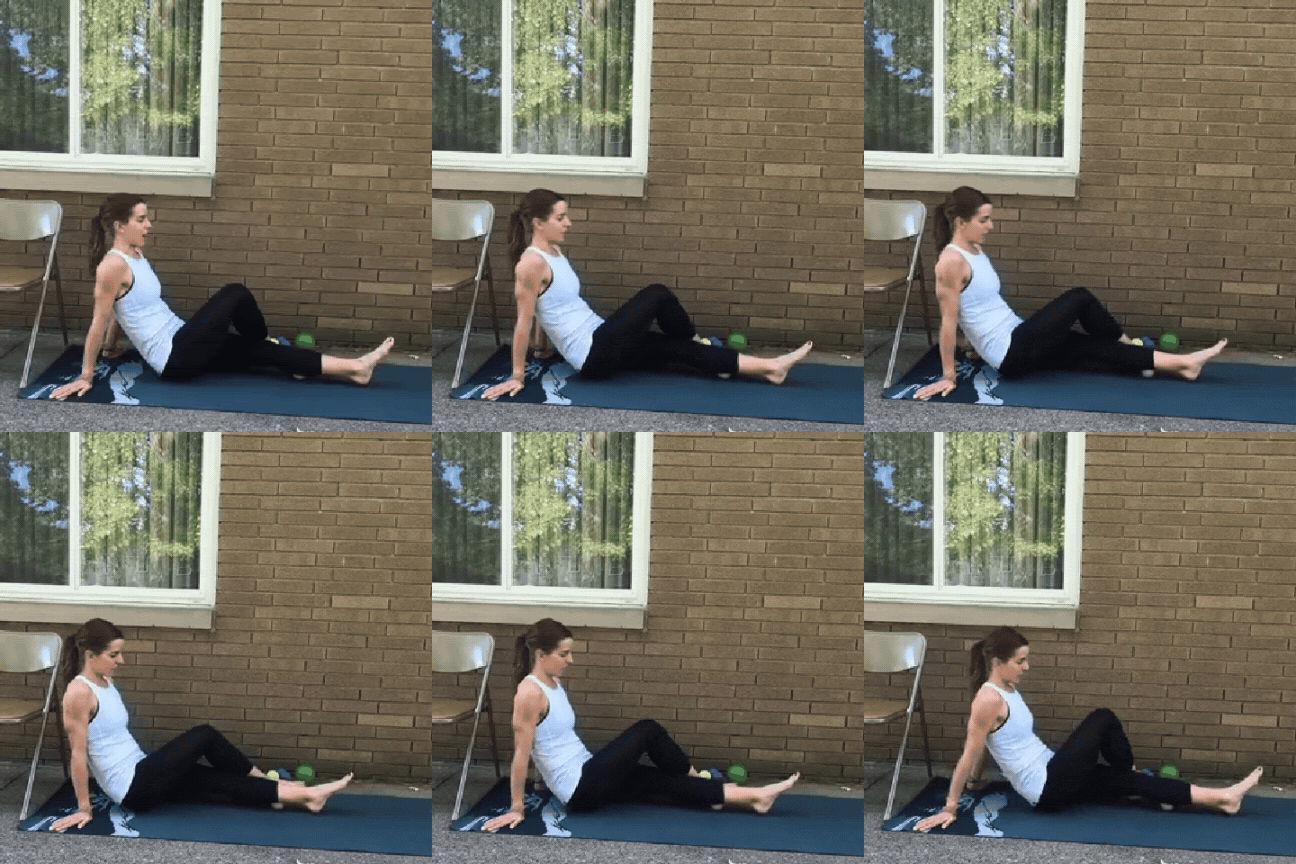
When I focus on my calves, staying in one place and breathing through it might be enough, or you can move to the side-to-side to find another spot. You may feel tighter on the inside of your calf. The key is to make sure you can fully relax your muscle. If you’re using a lacrosse ball but can’t relax, try switching to a tennis ball.
Exercise #3: Quadricep Active Release
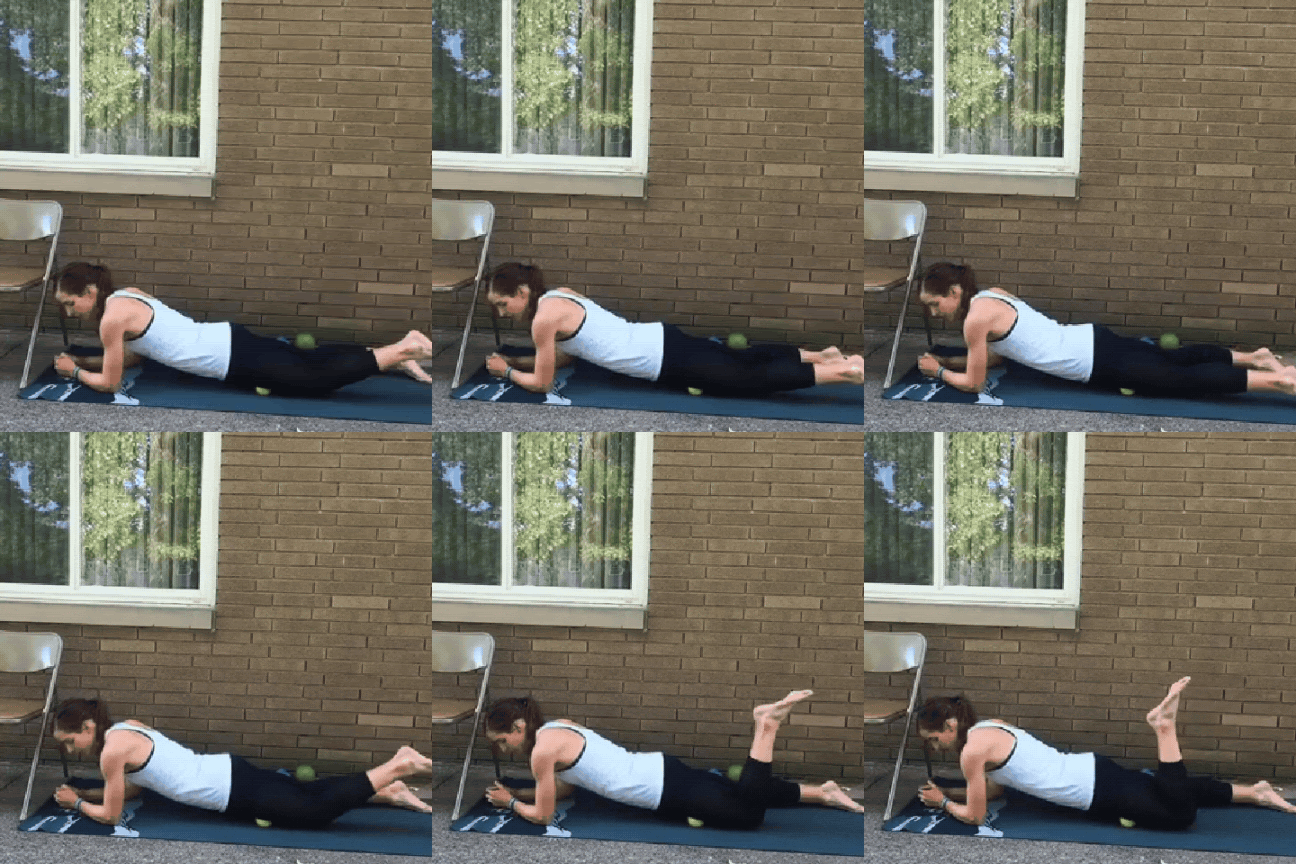
This is a big one for a lot of runners — the quads. I’m starting right in the middle of my quad. You can move up, to the side, or to the inside if that’s where you feel tightness. Remember to take deep breaths and relax.
Exercise #4: Hamstring Active Release
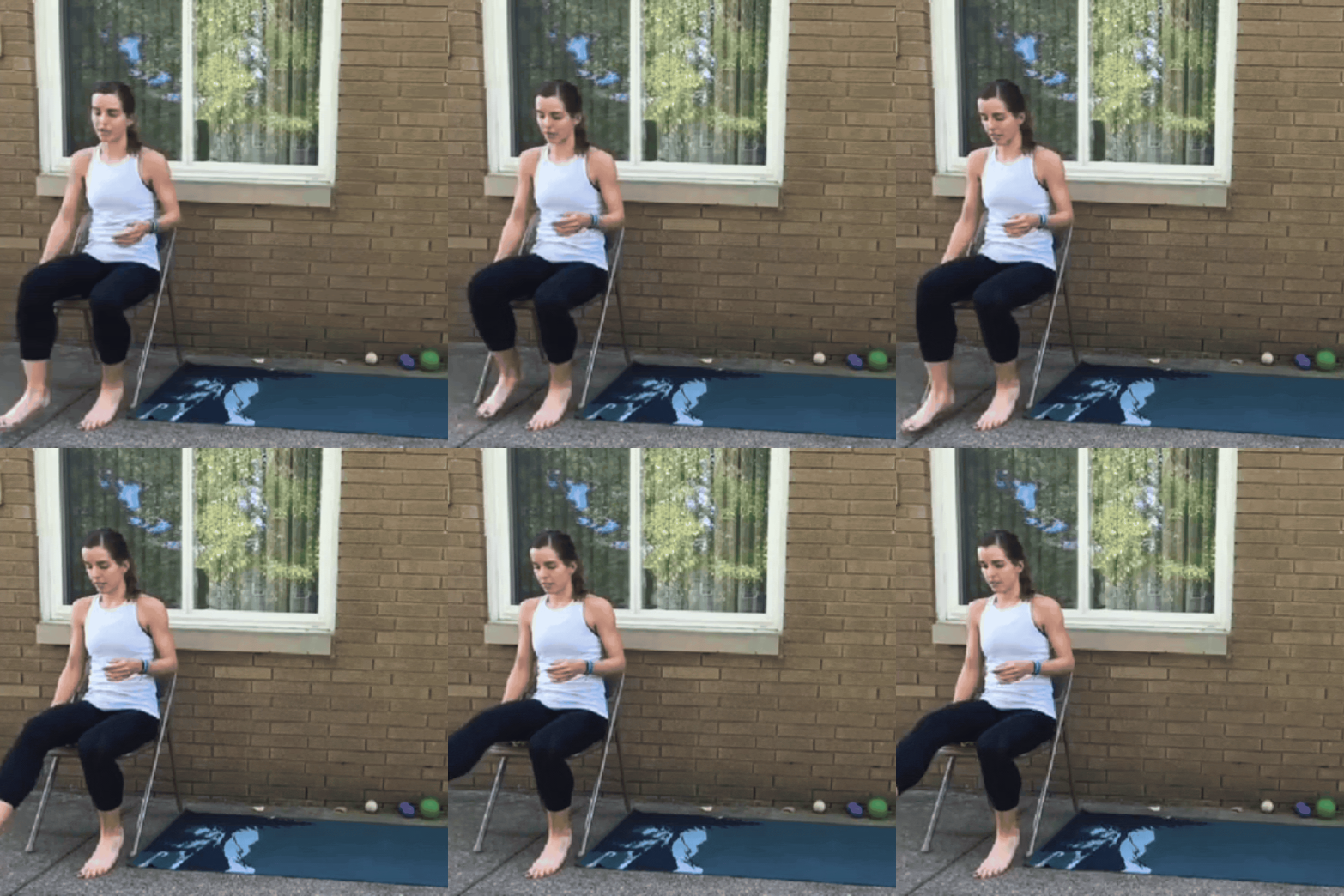
For this exercise, you’ll need a chair. I take a tennis ball and sandwich it in between the seat of the chair and my hamstring. This might be too intense for some people, so you may want to start with a foam roller on the ground and ease into it. I don’t typically have tight hamstrings, so I can handle this, but for others, it might be a bit painful — and that’s not what we’re aiming for.
I hope this gives you a few ideas on ways to work on some tight muscles. There’s even more muscle groups and exercises I didn’t get into today, but starting with just a few of these is a great start!
Form breakdown during long run efforts or races is inevitable.
But how do you know when you’re causing harm to yourself and should stop? Alternatively, when is it okay to push through and keep going? In today’s newsletter, Coach Sandi Nypaver gives you some of her tips to know the difference.
An athlete once approached me with the following question:
“When you (or any runner) start to feel your form fall apart, how do you know if you can keep going or if you should stop to avoid injury? I’m asking because in the few 50K races I’ve done, I’ve felt my form deteriorate between miles 20 and 22. If it were a shorter race, like a 50K, would you continue at that point? Fatigue seems inevitable in such long distances. I want to ensure I’m not causing damage by pushing through. Can you speak to the specifics of that?“
During an ultra or even a marathon, especially an ultra, there will be form breakdown. Expect it to happen! Often, at the end of these long ultras, you’re running quite differently than at the beginning due to muscle damage and form breakdown. If you’re running a 50K and feel your form starting to break down, it can be very normal and something you may want to push through, depending on the severity. If it’s primarily muscular fatigue rather than pain, it’s generally okay to continue.
There’s a difference between your legs feeling beat up and experiencing pain that might indicate an injury. Knowing what muscle fatigue versus pain feels like is crucial! You’ll have to listen to your body to know which one you’re experiencing, but here’s a good rule of thumb:
Fatigue
• More of a general, widespread sensation of tiredness and heaviness in the muscles.
Pain
• A sharp, stabbing sensation that will probably be more localized to a specific area in your body.
Ultimately, you’re going to have to listen to your body to know if you’re doing long-term damage or if you’ll need general rest and recovery from the big effort.
Understanding the importance of distinguishing between muscle fatigue and pain is just the first step towards maintaining your health. Equally crucial is knowing how to respond after completing a grueling race. Post-race recovery is not only about giving your muscles time to rest but also about ensuring that any form breakdown that occurred during the race doesn’t lead to long-term issues.
I emphasize the following to all of my athletes: after a race, yes, you want to recover, but in the next week or two, focus on technique work. What often happens after ultras is that people get injured a couple of weeks later because their form broke down, and they don’t take the time to ensure their stride returns to normal. They end up running with the poor patterns they picked up at the end of an ultra.
So, here’s a tip: in the week or two, or even three weeks, after an ultra or a marathon that really beat you up, take some time to focus on technique and form work. This way, you can avoid the “ultra shuffle” or any other weird changes to your stride. Spending a little time on technique after a race can go a long way! I have a variety of form-related videos on my YouTube Channel, or you can check out Higher Running’s resource webpage.
Remember, listening to your body and prioritizing both immediate recovery and long-term form maintenance is key to sustaining a successful and healthy running journey.
Marathon training isn’t rocket science, but there’s a few things to keep in mind.
Today, Coach Sage Canaday is discussing key components for marathon training!
Aerobic Base:
I see significant improvements in athletes who start running 30-40 miles (50-60 km) per week and gradually increase to 50-60 miles (80-100 km) per week without injury. This involves mainly easy pace mileage, about 80%, which is manageable but depends on several factors such as age, training history, and background in the sport.
Consistent, gradual mileage increase, proper nutrition, and lifestyle balance are also crucial. Most people benefit from running more frequently, transitioning from four days a week to five or six, and sometimes even seven days a week or twice a day. However, running twice a day usually applies to those running over 70 miles per week.
More Isn’t Always Better
I ran a marathon in 2:16, with a PR of 2:16:52. One lesson I learned is that more training isn’t always better. I ran 130-140 miles a week for years, but sometimes I overtrained, which actually left me tired and slower! I ran several minutes faster with less mileage, more targeted workouts, and by not overextending myself.
Effective marathon training involves several key components. After building your aerobic base with consistent, high mileage over months, you need variations in your long run workouts. It’s not just about hitting mileage numbers like an 18-mile long run, but about incorporating different intensities.
In our Higher Running Boston Qualifying Marathon Plan or BQ plan, available at Higher Running, long run workouts include segments at marathon goal race pace or even faster in the second half. These runs teach you to speed up when tired, mimicking race conditions where you enter with tired legs and low glycogen stores, even on a high-carb diet. It also helps with adaptations in fat burning and practicing your hydration and nutrition strategy during the run. Long runs aren’t just to “get in the miles”, there are times when they become demanding workouts that involve speeding up or running steady paces close to your marathon race pace when tired to mimic race-day.
The 80/20 Rule:
An 80-20 split between easy and hard runs has been recommended by coaches for decades. While recovery runs and easy pace runs are essential, incorporating quality workouts is crucial to reaching your marathon potential. Additionally, having a good nutrition and hydration strategy during the race optimizes performance and speed.
Intensity should be included in small amounts. From my experience running professionally post-college and training with an Olympic development group, it’s clear that interval workouts and faster workouts than your goal marathon pace are necessary. Many runners come from 5k, 10k, and half marathon backgrounds, which helps in preparing for the marathon.
Workouts around 10k and 5k pace should be used sparingly. For example, if your marathon goal is to break three hours (6:52 per mile pace), you should do some workouts closer to six-minute mile pace or threshold workouts faster than half marathon pace. These can include 800-meter repeats, kilometer repeats, or mile repeats at around 6:20 per mile pace.
These high-intensity workouts improve mechanical efficiency, increase aerobic capacity (VO2 max), and make marathon pace feel easier. They should be incorporated mainly in the last eight weeks before the marathon but can also be included early in the training cycle. Our training plans at Higher Running follow this approach, starting with shorter intervals to build efficiency, improve running form, and enhance aerobic capacity.
Race Day (and a quick note on nutrition)
A final note on marathon success is the importance of race day pacing. Conservatively pace yourself in the first 10K, relax, and warm up into the race. The goal is to maintain a steady pace in the last 10K. The key to a successful marathon is not falling apart in the final stretch. If you can speed up significantly in the last 10K, you likely paced yourself too conservatively. Most runners struggle in the last 10K, so it’s crucial to reach the 20-mile mark (32 kilometers) and maintain your pace.
Even if you slow down by 10-15 seconds per mile (or 8-10 seconds per kilometer), you can still run a good marathon. The real issue arises when you slow down by 30-40 seconds per mile (or 20 seconds per kilometer) in the last 10K, leading to significant time loss. Effective pacing involves running at a manageable, consistent pace with even splits. If you’ve raced a half marathon, use it as a benchmark. For example, to break three hours in a marathon, you should ideally have a half marathon time of at least 1:25-1:26 to aim for two 1:30 splits.
Nutrition is also crucial. Taking in carbs every 8K or 5 miles, either in gel or liquid form, helps maintain energy levels. Relying solely on fat burning without consuming calories during the race can hinder your performance. Hydration and regular intake of carbs can prevent hitting the wall and ensure you run to your potential.
In summary, successful marathon running involves balanced pacing, effective nutrition, and hydration strategies. Learning from past experiences, both successes, and failures, helps in achieving better results! I hope you find this helpful. Be sure to forward this email to a friend who you think would find these tips interesting!