For some runners, more volume can be very beneficial. For others, the main limiter is threshold fitness or raw speed. It comes down to knowing what’s holding you back. If your 5k-10k PRs are better than your marathon PR (i.e. you’re an 18 min 5k runner or faster) things that might help are more long runs with marathon paced work, a mileage increase, and/or more threshold runs.
Here are some threshold workout examples:
2 x 3 miles (2-3 min easy) at threshold pace (~6:42-6:34 min/mile, 4:10-4:05min/km)
10-12 x 3 min (1 min easy) at ~4-8s faster than threshold pace
2miles -2 miles -2 miles -1 mile (2-3 min easy) at threshold pace, or do a progression starting a little over threshold pace and ending the mile a little under.
However, before you start marathon training or in the first phase of training for a marathon, you’ll want to focus on faster, shorter workouts. This could be everything from 12 second to 1 minute hill reps, to 200s, and 3-4 min intervals at VO2 max pace. Then even as you get more into marathon specific training, you can still add in more touches of speed without running yourself into the ground.
These are some specific ideas:
8 x 30s (1 min easy) or 5-6 x 1 min fast (1 min easy) after the end of a threshold run
10 x 800m (1-1.5 min easy) at ~10k pace
But what if you’re already in your final 8 weeks of marathon training?
If you’re in your final 8 weeks, the goal shifts. You’re not trying to close the gap, you’re building fitness and getting comfortable at sub-3 pace.This could look like 4 x 3-4 miles at current marathon fitness pace builds the endurance and strength to hold your pace on race day. Or, 10 x 1 mile at 6:52/mi (4:16/km) gets you touches of sub-3 pace in your long runs without overdoing it, while still supporting your current marathon fitness.
Zone 2 training has become one of the most discussed concepts in endurance running, and for good reason. Easy aerobic running is foundational.
But when runners say, “I trained in Zone 2 for a year and didn’t improve,” the issue is rarely a lack of patience or discipline. It’s usually a misunderstanding of how Zone 2 fits into the larger training picture.
Easy running supports aerobic development and plays an important role in building tissue resilience and durability. It allows adaptations to accumulate through repeatable, recoverable training.
For many runners, “Zone 2” aligns with easy, conversational running. But for higher-level athletes, spending too much time near the top of that range can quietly turn easy days into moderate ones and interfere with recovery.
What easy running does not do particularly well on its own is prepare you for the demands of racing.
Race performance depends on more than aerobic capacity. It requires efficiency at faster speeds, tolerance for higher metabolic stress, and the ability to coordinate force under fatigue. Those qualities are trained through targeted exposure to higher intensities.
That doesn’t mean hard workouts year round. It means that at some point in a training cycle, most runners benefit from introducing small, intentional doses of faster running. This can include strides, tempo or threshold work, and occasional VO₂max efforts. Each serves a different purpose, and together they complement the foundation built by easy mileage.
Easy miles make harder training possible.
Harder training makes fitness specific.
Where easy running matters most is when you’re building the ability to train.
If you’re newer to running, returning from time off, or rebuilding mileage, keeping most runs easy while gradually increasing volume is exactly the right focus. At this stage, easy running strengthens muscles and connective tissue, improves coordination, and raises tolerance for frequency and consistency.
But when weekly mileage is very low, easy running alone may not provide enough total stimulus to drive meaningful performance improvements, particularly for longer events like the half marathon and above. In those cases, progress often comes from a combination of consistency, gradual volume increases, and complementary stress such as short intensity work, strength training, or cross training.
The goal isn’t to rush fitness. It’s to expand what your body can handle sustainably.
The real value of Zone 2 isn’t that it’s a special or optimal pace. It’s that it allows you to train more, more often, without breaking down. By keeping mechanical, metabolic, and nervous system stress low, easy running makes recovery and repeatability possible.
That consistency is where long term fitness compounds.
As weekly volume becomes more sustainable, easy mileage creates room for quality work to actually do its job. Zone 2 isn’t about chasing a number or a philosophy. It’s about building training you can repeat week after week.
One of the most important questions Coach Sandi Nypaver asks when reviewing an athlete’s program is: How are you responding to your training?
This matters because everyone responds differently. Take high-intensity VO₂ max speed workouts, for example. Some athletes thrive on them because they recover quickly and see big performance gains. Others? Even with great recovery habits, too many of these sessions can leave them completely fried.
That doesn’t mean those workouts aren’t valuable. It just means the way they’re integrated into your training plan should look different depending on how your body reacts. For some, sprinkling them in sparingly is the key. For others, they can be a cornerstone of progress.
And that’s just one example! There are countless ways training can impact you differently than someone else. So here’s the takeaway: Look at your training and ask yourself:Are you benefiting from it, or is it leaving you exhausted and holding you back?
Your response to training is the ultimate feedback loop. Pay attention to it, and you’ll unlock smarter, more effective progress.
Are you racing your speed workouts… or finishing them with a little gas still left in the tank? Coach Sandi Nypaver breaks down why she prefers consistently “good” workouts over a few “great” workouts.
One of my favorite reminders comes from Mark Coogan who is an Olympian himself and coach to stars like Emily Mackay and Elle Purrier St. Pierre:
“Ten weeks of B+ workouts are better than four weeks of A+ workouts.”
Coogan has coached two athletes to the Olympic 1500m final, so he knows a thing or two about smart, sustainable training. And the more I read from his book Personal Best Running, the more I find myself nodding along because his principles echo what I tell my own athletes every week.
What Does a “B+ Workout” Actually Mean?
The point isn’t the exact paces but rather the intent. You train hard, but not so hard that you’re emptying the tank every session.
For many runners, “10K pace” can mean very different things (running a 30-minute 10K versus a 48-minute 10K are completely different physiological demands). That’s why I often cue athletes to run intervals at their 30-minute race pace instead, because it anchors the intensity more precisely than a distance alone.
But the message behind the workout is the same:
Finish feeling like you could have done one or two more reps. Not that you couldn’t.
Why Backing Off a Little Works Better
Here’s what I’ve seen again and again as a coach:
Runners who “race their workouts” arrive at race day feeling flat. They’ve already spent their best effort in training.
Runners who train just a notch below their limit stay healthier, fresher, and more consistent. This is where long-term gains actually come from.
When you leave a workout with strength instead of depletion, a few things happen:
You can gradually increase mileage without breaking down.
You can handle more total reps at quality pace.
You avoid the spiral of exhaustion → illness → injury.
You show up on race day feeling sharp instead of drained.
It’s one of the least glamorous but most powerful truths in endurance training: Consistency beats hero workouts. Every time.
Do YouEverDo an A+ Workout?
Yes, but rarely.
Every once in a while (especially if an athlete isn’t racing tune-up 5Ks or 10Ks before a longer race), I’ll put in a single “A+ effort” workout: something that lets them go all-in and feel that competitive gear before race day.
Try This for a Few Months
If you’re someone who loves to “win the workout,” try dialing things back just a touch for a training cycle.
You might be surprised at how much stronger, healthier, and faster you feel on race day.
Hello Higher Running Family! Coach Rachael here and we have an article for you that may be of some interest for those of us who are now being thrusted into summertime training! The long, beautiful days do come with one notable challenge……heat! Training in the heat can lead to some wonderful fall/winter performances but we must be careful to stay healthy while our bodies take on the additional load of both cooling us while staying dedicated to our day-in and day-out training. That leads us to today’s topic of using a sauna to help the body better adapt to heat.
What are Saunas (hint there are multiple)!
Dry Sauna:this is a traditional sauna people will most readily find at their local gyms, YMCAs, etc. The temperature typically ranges between 150-185F (65.5 – 85 C) and the relative humidity is low 10-30%.
Infrared Sauna: a type of “radiation” that is also dry but at a lower temperature ~120-150F (49 – 65.5 C) and reportedly produces a more direct body heat. They are gaining popularity.
Wet Sauna or “Steam Room”:these are also typically not as hot as a regular sauna BUT they are very humid as the name indicates.
What Does the Research Say:
Something that should be noted about studies is their potential limitations. Sometimes data can be “self-reported” and, even with the best of intentions, this can lead to data error. Secondly, it is very costly to do long studies with numerous participants. Another consideration is individuals who have been training for a long time and do not opt to participate in studies that require deviation from their normal routine/training methods. The data in less experienced runners will show significant improvements because they are not close to their “genetic ceilings” while individuals who have been training a long time may show more subtle changes. With that said, these studies are still worth our time!
One study (cited below) showed very promising results by breaking up participants (both men and women) into two groups. One group received a dry sauna protocol while the others did not. They were given the same testing protocol at the beginning and then again after the seven-week study. What is particularly interesting is that they tested the participants at a particular blood lactate level: 4 mmol of lactate (30-minutes effort on a treadmill). Peak core temperatures and heart rate were lower in the group that received the sauna protocol and who also ran at a faster pace in their second test. The group that did not receive the sauna protocol did not show the same improvements.
It is believed that some of these adaptations occur from a positive change/increase hematocrit and hemoglobin levels (these are beneficial blood profile markers). Bonus! There are other noted health benefits to sauna, but for the purposes of this article, the athletic side is being discussed.
What Have I Personally Noticed:
I have been getting into a sauna 2-3 times a week for the past month, typically, after workout sessions. The sauna is rather dry and is about 170F (76.6 C). The first time I stepped into the sauna, I had to remind myself to take a few deep breaths (I have only ever stepped foot in a sauna once or twice in my whole life) and then I calmly sat for 20 minutes. I admit this was probably too long for the first session. Interestingly, it took me almost half the time I was there to get a noticeable sweat rate. During the second sauna session, I sweated much sooner (within a few minutes). My sauna sessions since then have been about 25 minutes.
NOW for the good part! Just a few days ago, I had a 5 x 1-mile repeat workout. The temperature was about 75F (24 C) and humidity was around 85%. Just a nasty day! Now that I have years of running under my proverbial belt, I know that I struggle in the heat and really pull back paces in the summertime. So, an average of ~6:20 minutes per mile pace for the 5 reps would have usually met expectations in a heat adjusted sense. However, I split 6:03 down to 5:52 which made that one of the best ever performances in the heat ever. Those paces were assigned without adjustment. Needless to say, I could not believe it when the paces were hit. I won’t lie, halfway through the final mile repeat, I was feeling the heat and effort, but this was a huge victory. The recovery time was about 2:15 – 2:20 minutes between each one. I started sweating early on during my warmup and sweated a bit more while working hard and this was desired. It is ideal to sweat a bit earlier to keep the body’s core temperature lower, but the heat adaptation occurs when the body may not need to sweat “as much”. I did go to the sauna right after this workout.
Now here is the thing: the gains will not be exponential from the sauna. There is an upper limit to how much the body will assimilate the benefits of the sauna and translate that into faster splits, lower heart rate at lactate threshold, etc.
Going forward, I plan to continue using the sauna about 2 times a week to maintain the newly acquired heat adaptation. The sauna is another training stimulus of sorts, and I will be watching for fatigue levels and adjust accordingly. Just like speed workouts and long runs, this is an additional stress to the body, and I will always put recovery first. If a sauna session needs to be missed, then that is ok!
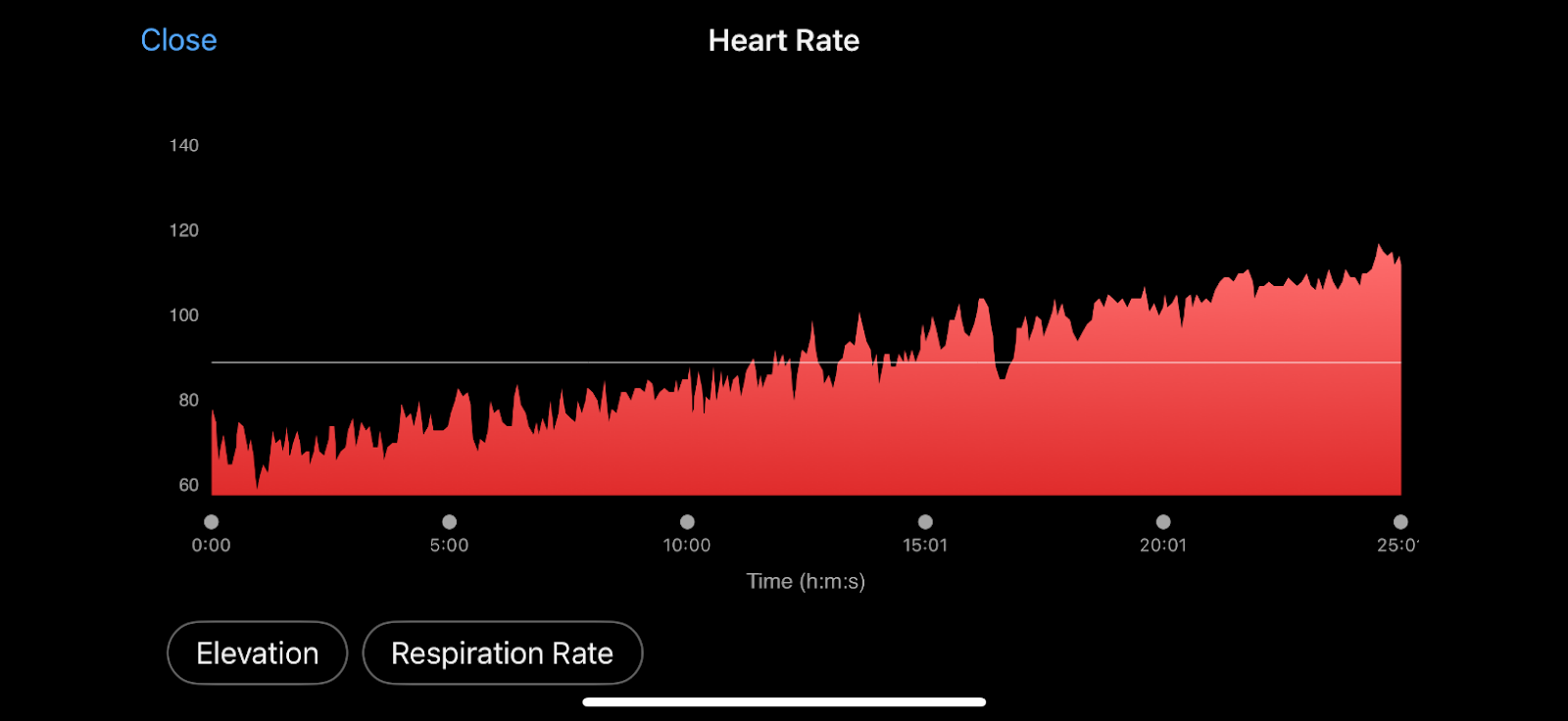
Now onto an explanation for the below image! I usually do not bring electronics into the sauna, but this time, I used my running watch and chest heart rate monitor strap to record the heart rate during a 25-minutes session. As you can see, my heart rate crept up the whole time, and it correlated with sweating and the sensation of getting hot. Around the 10-minute mark, I was sweating noticeably and at the end of the session, I had sweat “pouring” off me. I felt a bit uncomfortable around the 20-minute mark but perfectly safe to go the last 5 minutes. For context, this sauna session was after an 11-mile run which was a workout (8 x 800 meters and 2 x 200 meters intervals).
How to Implement, Cautions, and Who Benefits:
Please consult with your doctor if you have any concerns utilizing a sauna. While the sauna is well tolerated, there are certain medical conditions in which using a sauna is not advisable. For those who elect to use a sauna, hydration is very important! Not only do endurance athletes have to re-hydrate from their runs, but they also need to account for the sauna. Those prone to anemia/low iron stores, are well served paying special attention to their blood work. Lastly, please consider your total training volume. If the sauna proves to be too much of a stressor, it is arguable that more damage may happen than the modest gains from sauna exposure. Furthermore, if you are in the biggest block of training and only a few short weeks away from a major goal race, I personally would not recommend sauna exposure. A notable exception to this could be for athletes who are going to race in much hotter conditions than their current climate. Heat adaptations from the sauna can happen within just a few sessions and it would be a benefit provided the athlete monitors their recovery. The runner may need to scale back on intensity just a bit to make space for sauna sessions. Key take away: stay in tune with your body! There does not seem to be any need to go more than 4 times a week to the sauna. 2 times a week will also give benefits. If the sauna is completely new to you, 5, 10 or 15 minutes for the first session works just fine. Most protocols do not go past 30 minutes. After 30 minutes, I think the principle of diminishing returns comes into play as more hydration and recovery is required. Work the time up carefully and consider adding another day instead of long sauna sessions. The sauna is most effective if done very soon after completing a run.
The climate we live in could also indicate who gets the biggest gains from a sauna protocol. If someone is living in a cool climate and has opted for an early spring marathon in a warmer climate, this would be a great example of someone benefiting much more than a person already training in less-than-ideal conditions. Blood plasma volume (a marker of someone’s body prepared for heat) for someone who lives in Texas is, arguably, built up a bit more in early spring than someone from the far north. Therefore, the person living in the north could “play catch up” and build their blood plasma volume. Again, using a sauna should be done with caution and build up the time in the sauna gradually.
To summarize, I believe sauna training has a place in one’s training! Please let us know if you have used a sauna and what you noticed with your own running!
Sauna Alternate Options
Saunas may not be accessible for all individuals, or some folks may be traveling and do not have access to a sauna but want to gain or retain their heat adaptations. Well, you are in luck! There has been some attention paid to using hot water as a stimulus to raise the body’s core temperature. Around 100F for water temperature is ideal and stay in for roughly the same amount of time as would be done in a sauna. The key to water submersion is making sure the torso and arms stay in the water. Ideally, the entire body up through to the neck is best. The same benefits have been found with water submersion as compared to sauna: lowering of the core temperature, an increase in blood plasma volume, and muscle relaxation.