Today, we wanted to talk you through some of our most common questions we get about training as well as our own training plans.When you don’t have one-on-one coaching, it’s not always easy knowing what to do in instances of sickness, missing a workout, or having to adapt a training plan. Hopefully these answers will help guide you in your training!
Note: This is a longer read, so we’ve highlighted the questions in red, so you can skim for something you’ve always wondered yourself.
Q: What do I do if I get a 16-week training plan, but I only have 13 or 14 weeks until the race?
A: This partially depends on your overall fitness level. If you already feel like you have a good base and you don’t need a base, just remove the first couple of weeks. For most of our training plans, the first couple of weeks are focused on easier mileage, with maybe a lighter workout every couple of days. This is more so to prepare you for the weeks to come and make sure you have the base needed to really thrive using the training plan.
Now, say you feel like you don’t have a good base and you need those first couple of weeks to build your aerobic base back up. Our suggestion would be to look at the plan, ask yourself what you feel like are your running strengths (e.g., good at long, sustained tempo work), then ask yourself what week of the training plan would best suit your strengths, and those are the weeks that you could look at skipping. Focus on the weeks that are addressing your weaknesses that you feel like you need to work on.
It’s important to understand that with a question like this, there’s a lot of individual variables at play, such as the aforementioned aerobic base and your strengths and weaknesses as a runner. For Higher Running training plans, we usually try to help you feel as ready for the training plan as possible by showing you the prerequisites even before you purchase the plan (e.g., To use this plan, we suggest you’ve comfortably been running 25-30 miles per week all easy pace to be able to handle the volume). Don’t feel like you have to follow the training plan exactly to a tee, as they’re designed to be flexible, but these are all things to consider when trying to complete the training plan in a shorter amount of time.
Q: My main goal is to race a 100km race at the end of my 16-week training plan, but I also want to do a 50km race halfway through the training plan. What should I do in that situation?
(Or in situations where I have a B race halfway through training for my A race – choose you distances of choice)
A: We get this question a lot, and our thought is that even after a 50km, you’ll have to take recovery seriously. This means the week after the 50km you’re going to have to take it easy. You shouldn’t worry about the workouts or prescribed mileage, as you might not even run for most of the week. If you do run, focus on easy mileage. Then, your 2nd week post 50km, this is where you have to know yourself and be honest how you’re feeling. Some people may be able to jump in right where they left off. Others may still need to take it easy or reduce the volume of both the workouts and prescribed mileage.
You have to be really careful in the recovery and honest with yourself. Did you race this super hard and it’s going to result in 2-3 weeks of residual fatigue? It’s important to ask yourself what your true goal is, so if the 100km is your A goal, and the 50km is more of the “tune up” race, you could just use the race as a training effort like a long-run workout. (But it will still be a super hard workout regardless). Ultimately, don’t set expectations what you want your training to look like for the next 1-2 weeks post 50km race. Don’t try to push through the pain because you think it’ll help, because it will most likely end up hurting your 100km performance if you start things up too quickly again.
Q: If I get injured somewhere in the middle of a training plan, how do I come back? Do I start from zero? Do I jump in right where I left off?
A: This is going to vary from person-to-person and injury-to-injury. If you’re injured for a long time (several weeks), you’ll probably have to start from the beginning or even take a couple of weeks to even start truly training again. However, if you only have to take only a couple of days off, you might be able to jump in where you left off. Say you take off Monday, Tuesday, Wednesday and feel good enough to run Thursday, you can probably treat it as an easy to moderate run and reduce the volume of the run. Then for the next couple of days you still would reduce the volume and intensity of the run/workout.
Q: Okay, that makes sense about injury, but what about getting sick?!
A: This will vary depending on the sickness. If it’s just a cold and you have to take a day or two off, don’t worry about losing too much fitness. If it’s something more serious like the flu and you have to take a week or more off, you will probably have to ease back into things with reduced run volume and intensity. Depending on when the sickness or injury occurs, you could also just do an extended taper leading up to the race if your cautious and being honest with yourself.
All in all, if you happen to miss a few workouts or runs because of injury, sickness, or even life, it’s not going to totally derail your training. Yes, it might take you a couple of days to get back into the swing of things, but we’ve actually seen a lot of people improve significantly after a few extra days off because of the rest their body needed.
Q: Should I be weightlifting? If so, how would I incorporate this into my run?
A: There can be a lot of different approaches to this, but we can tell you what we typically do.
We like to do our strength/lifting sessions the same day as a speed workout. The optimal way to do it would be to first do the hard run, and then the weightlifting session later on in the same day. This way you’re keeping your hard days hard, and easy days easy.
Other programs say to fit in the weight training when you can, no matter where it falls. Again, we don’t do this ourselves, but you can always try it to see if it works for you. The one concern we have here is that if you do a strength training session, you may be too fatigued to fully benefit from a quality run session later in the week. Another potential risk we see with this method is your body being too tired from weightlifting, resulting in improper form during your speed sessions, and ultimately ending in injury.
We would say there is a difference for lighter core work sessions. These tend to not be too strenuous on the body, so we will fit these in whenever is convenient (usually aiming for 2-3x a week). Just know it’s okay to experiment with what method works best for you, we are more so just telling you what we’ve found to be successful in our own running.
Q: If something comes up in the middle of the week and I have to change my runs around, how do I go about that?
A: Our #1 tip for this is to never stack back-to-back speed workouts or even back-to-back long run workouts. Always have one easy day in between these key sessions. If it’s a really hard workout, you might even need 2-3 easy days in between. We know that the days we’ve scheduled a key speed session or long run in the training plan isn’t always going to work for everybody’s schedule. If you are losing some training days and/or time, you may have to skip a workout here and there. But our training plans are designed where a single workout is not designed to be “the” workout you need to do in order to make gains.
You’re probably reading this title thinking, “uh, what? That doesn’t seem right.”
Okay, okay, we simplified the concept a bit. But the true purpose of today’s newsletter is to discuss why rest and off seasons need to be taken seriously.
All Things Off Season (what is it, its purpose, etc): We always suggest to our athletes to take an “off-season.” (And for those of you new to running, an off-season is essentially a time of the year you use to take a break from your typical running training cycles and routines. Perhaps you switch it up with cross training, more time off in general, etc). These typically range from two weeks to maybe even two months. Some athletes take theirs around the holidays, others take theirs around this time of the year when it’s cold and snowy out to enjoy some other winter sports like downhill or cross country skiing. There’s no ”right” time to take an off season, but rather it should be tactically planned around your goals for the year. For example, say one of our athletes doesn’t have a goal race until July of 2023, and then more races planned for the fall, this means that the winter (so around this time of year), is a great way to take an off season and let the body reset.
What I’ve noticed over the years of who I coach, is that athletes who can take a true off season often see bigger gains that following year or the years to come. And don’t get me wrong, it’s really hard to deliberately choose to lose that fitness. After all, you’ve worked so hard to get there, why would you want to throw it all out the window?! But the thing is, if you try to hold on to your peak fitness, you’re going to end up slipping backwards.
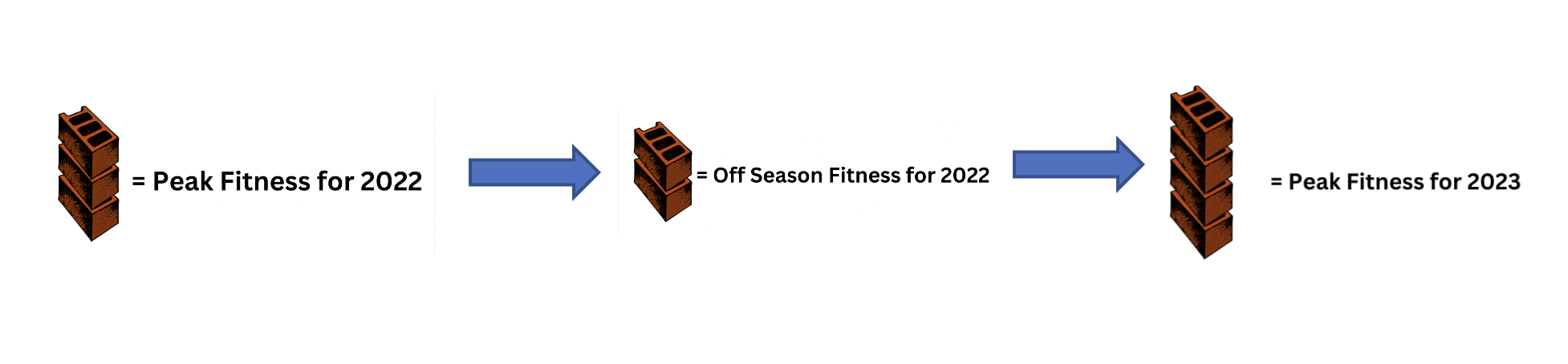
Fitness is Like a Brick Wall: Imagine your fitness is a brick wall. Over the past year of 2022, you’ve worked hard to build your fitness up to a total of 3 bricks strong. This is AWESOME! It’s the most amount of bricks you’ve ever been able to build up to during a season. When you take an off season or a break from running, realistically, you’ll only end up losing about one brick’s worth of fitness. Not too bad, right? Well, this then gives you the ability to build your fitness up to four bricks strong for the 2023 season. You still had the foundation of your two bricks, and better yet, you could build off of that and continue to get more fit than you ever have before. If you’re a visual learner, here’s what I mean:
There’s a bit more nuance to all of this, and of course there are limitations and exceptions, but this is the general idea of why you take rest periods. You will not be starting from 0, but losing a little fitness ultimately helps you gain more fitness in the years to follow.
Running and Self-Worth: To those who really struggle to let go of big training weeks, I find that it’s important for them to look inwards and ask themselves if they’re perhaps putting too much of their self-worth in running. And to those people, I hear you! I’ve been there. In fact, most of my life I’ve been playing various sports and always struggled with putting a lot of my self-worth into athletic outcomes or how much training I was doing. I ultimately figured out that this actually hurt my performance, made it unenjoyable. I would’ve done better if I had just taken the rest when I needed it.
Your self-worth should never be tied to running. Try to find other things that you can do while your body takes its time to rebuild itself. Again, I know this is easier said than done. But, I was somebody who always put my self-worth into sports and couldn’t find happiness somewhere else, but this was just a lie I was telling myself. When I realized this, I was able to find joy in so many things – helping people, being of service, adding quality to other people’s life. This may look different for you, but I truly think there’s always a wide variety of things people are good at and enjoy.
A heart rate monitor is great tool, but here’s some of the mistakes Coach Sage sees most often when used by runners. Coach Sage has touched on this topic a lot over the years, but he thought it needed to be updated based on some new technologies, the latest research, as well as people asking a lot of questions about heart rate based training.
🥇 Don’t compare your heart rate to others.
The first mistake people make is comparing their numbers to other runners. The numbers are relative. It’s very genetic-based when it comes to your heart rate. This is true for your maximum heart rate, as well as how your heart rate may change over time. You may have heard the rule of thumb that as you get older, it drops one beat per year of life, or it’s 220 minus your age. This is not usually the case! 🙅
Your heart rate changes as your fitness improves – especially your resting heart rate. Your whole zones could also shift over time, so me (Sage) running at seven-minute mile pace (or four minutes per kilometer pace) at 150 beats per minute, and you’re running at that pace at 180 beats per minute doesn’t necessarily mean you’re working harder or closer to your threshold than me. It may be the same sort of effort for you even though your heart rate number heart rate value is totally different. Likewise, someone may also be at 120 beats per minute and be breathing very hard and working very hard. The important take away is that there is some genetic variation in heart rate ranges between your max and your minimum heart rate.
📣 It’s NOT worthwhile comparing heart rate numbers, so don’t get caught up comparing yourself to your peers. 📣
🥈 Don’t be a slave to your sensor.
The second point I want to make is don’t be a slave to your sensor! There’s a lot of sensor error that can happen — even if you have something like a chest strap. It could trip errors, like accidentally tuning into your cadence (i.e., how many steps you’re taking in a minute). Even if you have some chest hair, it may read inaccurately. If the strap’s too loose or too tight, or it’s not getting a good connection with the electrical signals of your heart right, again, these things all cause errors.
Same thing with optical straps and sensors, which are typically found on the back of high-end running watches. These are even less accurate, generally, because for them to work, it needs to be very sensitive to surges of blood in your veins using an infrared sensor. That doesn’t always work a lot of times for many people — especially if it’s cold outside and you have cold hands. Additionally, the circulation differs between people, and yet again, the genetic variation comes into play. Finally, wrist straps are not great at getting an accurate reading especially when you’re running or you’re exercising, because your heart rate is constantly changing and fluctuating. So realize your threshold zones don’t magically change by a huge amount overnight. You don’t reach a new max without knowing it!
Now let’s talk about what IS valuable when it comes to heart rate. There is value in your resting heart rate. To get this number, you could use a sensor like a pulse oximeter at resting levels. When you wake up in the morning and you’re calm and relaxed (before you’ve had any coffee or other stimulants), you could try to get a resting pulse resting heart rate reading. Of course, you could do that manually over a span of 60 seconds by counting how many heart beats you feel. Do this by placing your fingers on your throat (you can also Google how to do this) or just over the heart to get a pulse reading over 60 seconds. If you track your resting heart rate over time and it comes down, it’s a good indicator your aerobic fitness is improving.
You can also use resting heart rate as an indicator if you had a stressful event going on. Maybe you had a bad night of sleep. Maybe you drank too many beers the night before! Maybe you’re over training a little bit. All of these things would most likely result in you having an elevated resting pulse in the morning. In conclusion, it’s not a bad idea to keep track or a log of your resting heart rate to see how it changes over the course of your training cycle.
🥉 Most people don’t know their true, 100% max heart rate. The third mistake people make when training to heart rate, is if they’re doing “zone training” (e.g., Zone one, two, three, four, five), but not actually basing their zones on their true, 100% max heart rate. Some people like to use arbitrary formulas like, “220 minus your age” to find your max heart rate or “180 minus your age” to find your easy aerobic range. These numbers don’t always work as there’s a lot of genetic variation and your heart rate ranges and values are a moving target. A lot of people will not know their hundred percent max heart rate and there are only a few “good” ways to figure it out. The first is a Vo2Max test in a lab which will usually allow you to get up to a 100 max heart rate. There are some workouts and tests you could do, like a well-paced 3k race or two-mile race for example, progressively loading, and building to that hundred percent. But it’s very painful and still very hard to pull out of 100 max heart rate value. In reality, trying to base your zones off your 100% max heart rate is kind of a crap shoot, and that’s why I wouldn’t be a total slave to the numbers and the sensors without knowing getting some vo2max testing if that’s the route you want to go.
If you remember anything, remember this: 🙌
If you want to “un-complicate” your running life, here’s what I try to encourage my athletes to do: Go by perception. Go by your breathing rate. Know that if you want to build aerobic base, most miles are going to be low intensity aerobic base building miles. Even most of my miles (~80%) are these easy, base building miles.
Coach Ray loves a good mindset tip. They do truly work…for a lot of people, but not everyone. So what happens when you still feel stuck, the anxiety doesn’t go away, or your inner Negative Nancy* is the voice still running the show?
*I apologize to anyone reading this named Nancy. This is simply the name I grew up with and that I use when I’m doing my own “Parts Work” (IFS).
This series offers a slightly deeper dive into mindset from a mental health therapist’s point of view.
Negative Thoughts
As strange as this may sound, most negative thoughts are trying to protect us from feelings of disappointment and shame. For example, if we’re worried we won’t hit a pace, the brain thinks it will save us from the uncomfortable feelings by telling us to not even try. To challenge negative thoughts, first try out some of our mindset tip “go-to’s”:
This is one of my favorites from Coach Sandi: Notice the negative thought, then switch your focus to how you want to feel. (This simple switch actually will light up different parts of the brain and affect what hormones are coursing through your body.)
Practice mindfulness: Notice the negative thoughts, label them “that is a judgey thought”, let them pass like clouds, and return to your breath. Thoughts are often just thoughts and the ones that stick are the ones we choose to give power too.
Here’s where we start to switch to more therapy skills:
Acknowledge the thought, or fear. Reply to that thought, or your inner Negative Nancy “I see you. I know you’re trying to help, but I’ve got this.”
If the negative thoughts still persist, it’s okay to seek out a therapist. Because the hippocampus makes future predictions based on past memories, you may need to go back and explore the time when the thoughts and feelings first originated. Be curious, and be kind to yourself.
Pre-Race Anxiety
While pre-race anxiety is considered “normal” I actually don’t believe it has to be, though I’ve admittedly not overcome that feat just yet. So for now, we can say that pre-race anxiety can be greatly reduced.
Mindset- Nervousness vs. excitement; threat vs opportunity for growth. Viewing how you see pre-race anxiety can absolutely change the effects of it. When you label the feeling as excitement or a sign that you simply care about the race, this thought (in the brain) signals to the body that it’s safe, and therefore your muscles and mind can relax a little. Same as viewing a race as threat (“I’ll be a failure if I don’t meet my goal”) vs. an opportunity for growth (“I’d really like to hit my goal, but even if I don’t, it will be a beautiful opportunity to see how well my physical and mental training is going. Plus, my family and friends love me no matter what.”) These thoughts can actually change what hormones the brain releases, whether they be stress or motivating and feel-good hormones.
Dive into the fear: This one is counter-intuitive for many people, but as a therapist, this is how I work with my clients who experience anxiety. Go into the fear. Examine it like a detective. Where do you feel fear in your body? Can you describe the sensation? What is the belief the fear is carrying? And most importantly, how can you reassure yourself that you’ll be okay? If the negative thoughts persist, and/or you feel overwhelming anxiety (puking before a race), or this feels like it’s too much to do on your own, seeing a therapist can help guide you.
Good Pain vs. Bad Pain
Simply put, good pain is the pain that will physically help us get stronger and mentally help us grow. It can be your lungs burning during a workout session or the muscle fatigue starting to set in at the end of the race. This type of pain is to be only experienced periodically during a weekly training block. A little helps us grow, too much leaves us fatigued.
Bad pain is the pain of pushing through an injury or illness and is associated with the thought of needing to prove ourselves (ie. our toughness, worthiness, enoughness, etc.)
This is a play on semantics, but I like to say “You don’t have to be tough to be strong.” Strong is knowing that our pain carries wisdom and with it the intelligence to listen (rather than ignore) our bodies.
Bonus:
“Higher levels of stress cause higher cortisol output via the HPA axis, and cortisol inhibits the activity of the inflammatory cells involved in wound healing.” -Gabar Mate, When the Body Says No
High levels of stress can not only slow healing if you’re experiencing an injury, but it can also slow down recovery time. This is obviously not what you want when training for a race, or simply for the joy of running. But how do we actually reduce stress?
1. If possible, change your lifestyle. Learn how to say no.
I know changing a lifestyle, quitting a job, moving, etc., isn’t possible for everyone. What is possible for more people is saying “no.” Quit agreeing to take on projects that don’t make you excited, kindly decline the invitation to the dinner party, and for goodness sake, it’s 100% okay to buy cookies for the bake sale at your kids school.
2. Change your perspective.
Is what you are stressing about really that important? A lot of people have a tendency to make a big deal out of small things, things that really aren’t that important. Practice zooming out, like you’re on a mountain looking down at your life, and put things into perspective. What really matters? Humor is also a good tool. Laugh at yourself and your humanness. While life is meaningful, it’s really not that serious.
3. Feel your emotions, let them move through your body, and self-regulate. Emotions are simply the messengers of our body. They are meant to be listened to. Unfortunately, a lot of times they are pushed down, and this actually affects our nervous system and our immune system. If you’re thinking “How in the world do I feel my emotions?”, it might be a good time to speak with a therapist or read a book by a mental health professional.
Hello Higher Running Family! The topic of running in the heat is very much on the forefront all around the country and for good reason! Much of our great land is enveloped in various heat waves, bringing in record setting temperatures and general safety concerns for people, animals, and infrastructure. I wanted to create a little article to go hand in hand with a Higher Running YouTube Video about heat training.
Like always, please ask questions or if you have any great hot weather training tips, feel free to share. In the article, we will chat about heat factors and how it affects the body, guidance for how to workout in the heat, what to watch for regarding heat exhaustion, and some tips and tricks for staying cool in this weather.
Let’s Begin!
“Oh but it’s a dry heat” “Yeah, so is a fire!” I love the back and forth regarding which heat is worse. Humidity causes the body to work even harder to cool itself while dry heat can really sneak up on you because one may miss cues that they are in fact sweating a lot. Evaporation means I didn’t sweat right?
Before we discuss strategies on how to prepare for heat, lets talk about how the body responds to heat from the aspect of thermal homeostasis and the autonomic nervous system. Don’t worry, we are not going to get too much into the science of this but rather the practical application.
The warmup is always important for a runner to help prepare oneself for the main portion of their run/workout. From the aspect of heat, it is important to let your heart rate come up gradually. The body is warming up and so is the core temperature. To combat too high of a core temperature the body starts to sweat. Blood flow must be diverted to the skin, and all of this requires a little more work from the cardiovascular system. Therefore, heart rates are usually a little bit higher at a given pace in the summer versus winter. The general autonomic nervous system (without going into to too much scientific detail) is what regulates these physiological and chemical functions. Just like any computer or piece of machinery, a series of instructions takes place and then a response is produced. Basically, the body needs just a little bit of time to compute what it is being asked to do and how best the body would like to maintain its thermal homeostasis. If one warms up too quickly, they risk raising their core temperatures past the rate in which the body perceives the increase in heat. For the data minded folks, this is what leads to heart rates suddenly shooting up in the beginning of runs and the risk of not recovering from that sudden spike. The body is constantly trying to play catch up in already challenging conditions. This is really the main thing I see, from a coaching perspective, that causes runner’s issues in the heat. If the first, say, 15 – 20min of a long run can be spent at a gentle and mildly progressive pace, the body will be just that more prepared for the rest of the run.
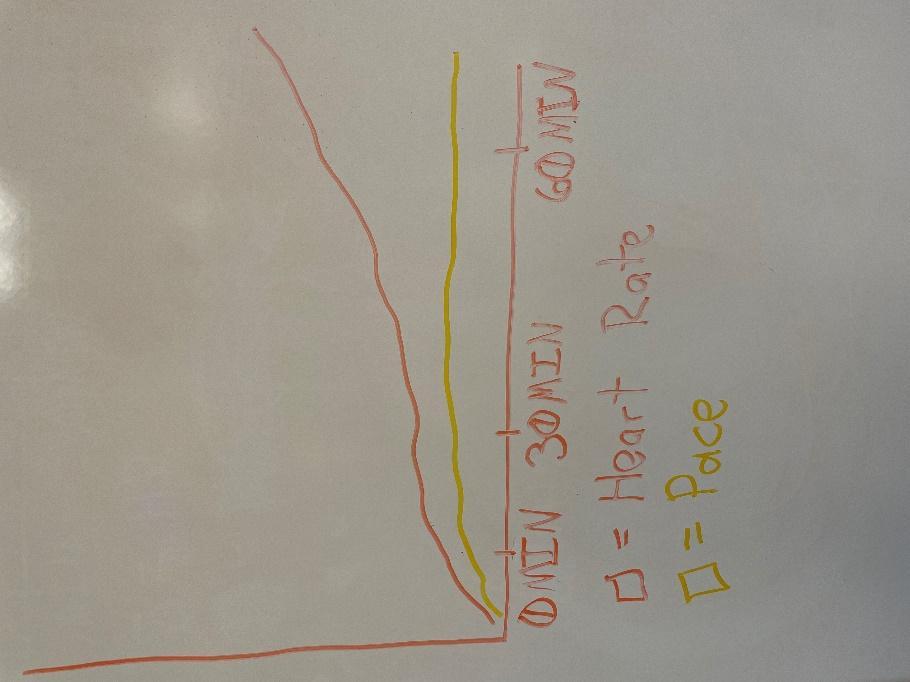
Another aspect to cardiovascular data in running is decoupling. Even with a proper warm up, there is only so long the body can withstand having two demands being placed on it: cooling itself and exerting itself. Decoupling refers to the heart rate graph and a given running pace/effort becoming separated. Imagine a graph in which a heart rate line is staying consistent with a pace but as the body fatigues, imagine the heart rate line trending up (higher) while the pace/effort line stays the same or declines. Some decoupling from heat and/or fatigue is very common and nothing to be too scared of but is one important metric to monitor. Watching for sudden decoupling is very important and this can happen within minutes.
Before we move on to tips and tricks for exercising in the heat, let’s review a few symptoms that are indicative of heat fatigue or heat exhaustion.
-Goosebumps on the skin (usually an early clue)
-Sudden increase in sweating (earlier clue)
-Sudden decrease in or cessation of sweating (this is dangerous)
-Clammy/pale skin (need to stop the activity)
-Dizziness or sudden weakness (need to stop the activity)
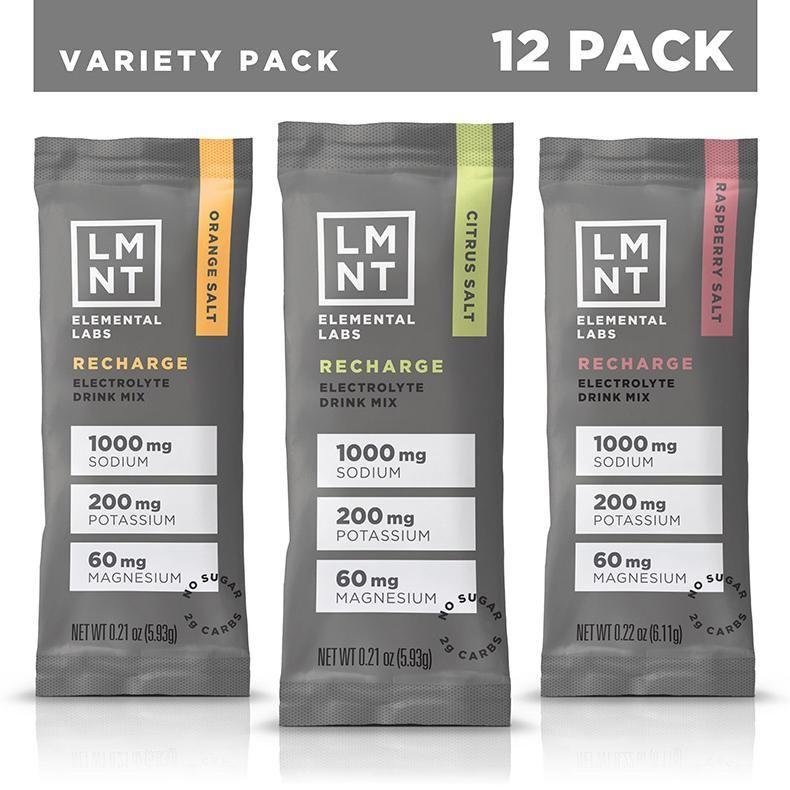
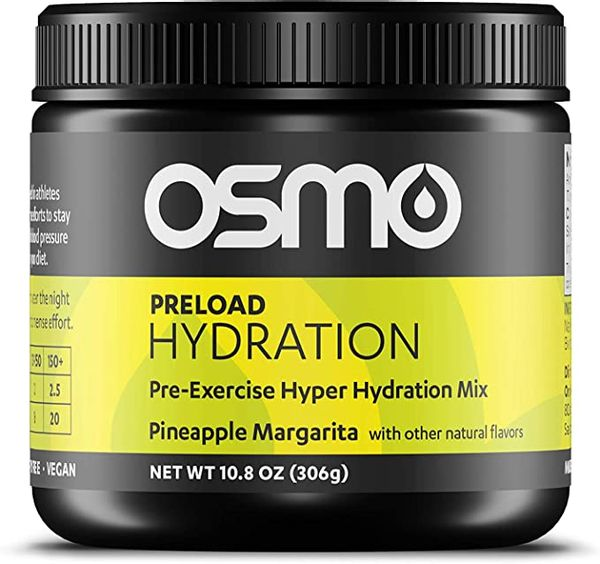
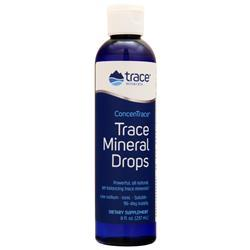
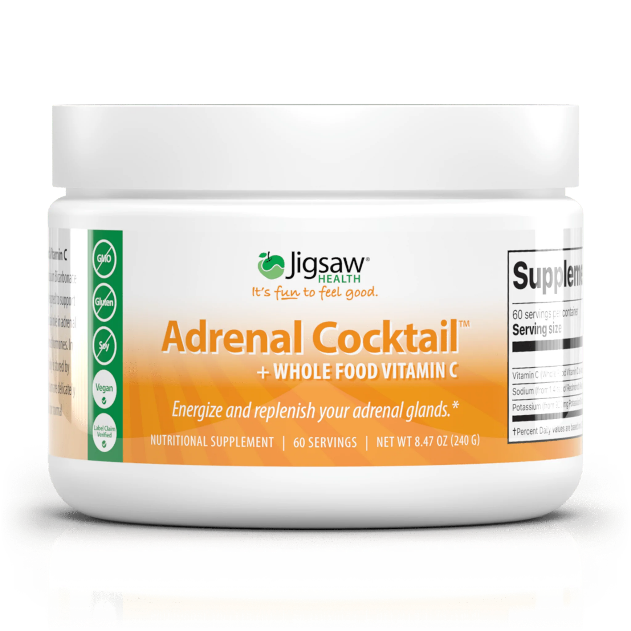
Now let’s end this on a positive note! The human body is remarkable and with proper care, we can adapt and train in warm conditions. Hydration is critical and possibly the most talked about point with heat training. Specifically, lets talk about pre-loading of electrolytes. It is important to have a steady supply of electrolytes and probably some glucose to go with it for activities lasting longer than 60min. More studies have come out that suggest the body will sweat a bit more efficiently if it is loaded with salt, optimally, before the exercising takes place. For those who have kidney or high blood pressure issues, it is recommended that you check with your primary care physician before loading up on salt. A strategy is to consume a beverage higher in salt the night before and then again prior to exercising in the heat. I am not sponsored by any nutrition companies so if I recommend a product to explore, it is because I have had success with the product. To help with salt intake, the concentration for hot weather athletes needs to be substantial. 300MG of salt, for example, isn’t going to cut it. Plenty of folks lose 700 – 1500mg per liter of sweat (the range can vary even more). Coach Sandi helped create Unived’s Elite Hydration Mix for this reason. Unived is a great company that shys away from artificial flavors and puts a lot of effort into making a product that is easy to digest. If you would like to try Unived, Coach Sandi has a code: SANDI10 for 10% off. I, personally, consume a lot of LMNT (1000mg of salt per serving) and also occasionally use OSMO Pre-Load (1750mg of salt). I am also not afraid to salt my food. Lastly, it can be fairly easy to have out of balance minerals and vitamins when sweating heavily day in and day out. As a safety net for general health, it is recommended that athletes keep tabs of their blood work. If an athlete has ever had an issue with low mineral levels, anemia, etc., it is not unreasonable to have blood work done four times a year. I have listed below a few nutrition supplements I use. Companies like Athlete Blood Test can even let you know if you’re getting in enough or too much sodium and other electrolytes. I have used Athlete Blood Test for about 3 years and Coach Sandi and Sage also utilize ABT for their needs. Sandi has a code for 15% off: sandi15.
I hope this helps get you to feel more comfortable running in the heat! As always, please feel free to reach out if you have any questions about heat training or any other training needs, please ask! If you’re interested in learning more or want to be coached by me, you can learn more here: https://higherrunning.com/the-team/