If you’re looking to go sub 40-minutes or even sub 50-minutes in the 10km, then this newsletter is for you! Coach Sage Canaday will be giving you specific workouts and running tips to lower your 10km time. The examples he uses will be tailored towards those trying to go sub 40 minutes in the 10km, but know that a lot of the workouts and pieces of advice can also be applied if you’re trying to get a 10km run below 50, 45, or even 35 minutes. Even if you’re training for a 5km, this is all information that can still be applied, too. Here we go!
Let’s start with some simple math before we get started. If you’re aiming to run a sub 40 minute 10km, your race pace is going to be 6:26min/mile or 4min/km. This is important to keep in mind as we detail the workouts and pieces of training advice.
STEP 1: The first step is one we’ve preached in numerous other newsletters and training talks… can you guess? It’s to build up your weekly mileage (i.e., aerobic base). Even though it seems so simple, consistent training, the better stamina and endurance you’re going to have to run a faster 10km. It’s important to notice that this aerobic base building phase applies to whether you’re wanting to run a faster 5km or 100 miler. You can’t go wrong building up your weekly mileage in a progressive manner. Here’s the practical way to do this: if you’ve been consistently running 3-4 times per week, try to start running 4-5 times per week (or even 6 times per week if you have the time!). You’ll notice your body start to adapt to the training load, and naturally, you’re aerobic base will help you run faster. Not all runs need to be super long or hard, it’s the consistency that matters. If you’re aiming for a sub 40 minute 10km, most “easy paced” runs will be at 8 minute/mile pace or 5 minute/km pace.
STEP 2: A second point I want to note is just because you’re going to be running 10km, doesn’t mean you shouldn’t be running longer than 10km for your long runs! Many long distance 10km runners will work up their long runs to 16-20km on training days. Don’t limit yourself to only running up to 10km because the extra mileage during your long runs will help contribute to your stamina and leg strength. Note: this same rule typically is not applied towards longer distances like marathons or ultras. If you’re training for a marathon, one does not usually run over 26.2 miles during training, or even full marathon for that matter.
STEP 3: Now let’s move on to the fun stuff, the speed workouts needed to run a fast 10km! Speed workouts don’t always need to be done on the track, and they should never be “all out” type efforts that have you laying on the ground gasping for air. However, they are always going to be substantially faster than your goal 10km race pace. Start by doing what we call “economy” or “efficiency” workouts. Typically, these take the form of 400m or 800m repeats. If a sub 40 minute 10km is your goal, you’d be targeting 2:55 for 800m. For 400m repeats, start by doing 4x400m at 1:24 per 400m with a 2-minute rest in between. You can then work your way up to 6x400m and finally 8x400m. As for how these should feel, it should be a medium-hard type of workout. During the actual speed portion, it’s going to feel really hard, but the rest in between should hopefully be able to alleviate some of the pain and get you ready for the next one.
STEP 4: You then move from “economy” or “efficiency” workouts to tempo workouts. The bread-and-butter tempo workout we prescribe is the “20-minute Tempo.” You can warm up for a few kilometers, and then you jump into a 20-minute tempo run with a pace that is very close to your 10km goal pace. So again, if you’re aiming for a sub 40-minute 10km, you would be running this tempo run at about 6:36/mile or 4:08/km. This workout should not feel all out, but more so help your legs feel what it’s going to be like to run near your goal race pace for the 10km.
STEP 5: To bring it all together, the final type of workout you will need to do are V02 max type of workouts. And yes, these are the workouts that are going to sting compared to the others. They are aerobic capacity type of workouts where you will be running the reps at 5km pace or even faster in order to get your heart rate up to 100%. The way to implement these are through longer efforts, such as kilometer or mile repeats at a high intensity interval pace. For a runner aiming at the sub 40-minute 10km, a sample workout would be 4 x 1 mile (1600m) at 6:10 pace with a 4-minute rest in between. Another workout could be 6-8 x 1000m at 3:50/km with a 2-minute rest in between. These are tough workouts, but it’s not like you need to be doing them every other day. Realistically, you be throwing in one of these hard workouts every week or two.
Pulling this all together, you’re going to have 80% of your running be the easy, base building type of runs. Throughout the training cycle, you’ll start to sprinkle in economy workouts, then tempo workouts, and ending with the V02 max type of efforts to help your heart pump more build to your working muscles.
Today, we wanted to talk you through some of our most common questions we get about training as well as our own training plans.When you don’t have one-on-one coaching, it’s not always easy knowing what to do in instances of sickness, missing a workout, or having to adapt a training plan. Hopefully these answers will help guide you in your training!
Note: This is a longer read, so we’ve highlighted the questions in red, so you can skim for something you’ve always wondered yourself.
Q: What do I do if I get a 16-week training plan, but I only have 13 or 14 weeks until the race?
A: This partially depends on your overall fitness level. If you already feel like you have a good base and you don’t need a base, just remove the first couple of weeks. For most of our training plans, the first couple of weeks are focused on easier mileage, with maybe a lighter workout every couple of days. This is more so to prepare you for the weeks to come and make sure you have the base needed to really thrive using the training plan.
Now, say you feel like you don’t have a good base and you need those first couple of weeks to build your aerobic base back up. Our suggestion would be to look at the plan, ask yourself what you feel like are your running strengths (e.g., good at long, sustained tempo work), then ask yourself what week of the training plan would best suit your strengths, and those are the weeks that you could look at skipping. Focus on the weeks that are addressing your weaknesses that you feel like you need to work on.
It’s important to understand that with a question like this, there’s a lot of individual variables at play, such as the aforementioned aerobic base and your strengths and weaknesses as a runner. For Higher Running training plans, we usually try to help you feel as ready for the training plan as possible by showing you the prerequisites even before you purchase the plan (e.g., To use this plan, we suggest you’ve comfortably been running 25-30 miles per week all easy pace to be able to handle the volume). Don’t feel like you have to follow the training plan exactly to a tee, as they’re designed to be flexible, but these are all things to consider when trying to complete the training plan in a shorter amount of time.
Q: My main goal is to race a 100km race at the end of my 16-week training plan, but I also want to do a 50km race halfway through the training plan. What should I do in that situation?
(Or in situations where I have a B race halfway through training for my A race – choose you distances of choice)
A: We get this question a lot, and our thought is that even after a 50km, you’ll have to take recovery seriously. This means the week after the 50km you’re going to have to take it easy. You shouldn’t worry about the workouts or prescribed mileage, as you might not even run for most of the week. If you do run, focus on easy mileage. Then, your 2nd week post 50km, this is where you have to know yourself and be honest how you’re feeling. Some people may be able to jump in right where they left off. Others may still need to take it easy or reduce the volume of both the workouts and prescribed mileage.
You have to be really careful in the recovery and honest with yourself. Did you race this super hard and it’s going to result in 2-3 weeks of residual fatigue? It’s important to ask yourself what your true goal is, so if the 100km is your A goal, and the 50km is more of the “tune up” race, you could just use the race as a training effort like a long-run workout. (But it will still be a super hard workout regardless). Ultimately, don’t set expectations what you want your training to look like for the next 1-2 weeks post 50km race. Don’t try to push through the pain because you think it’ll help, because it will most likely end up hurting your 100km performance if you start things up too quickly again.
Q: If I get injured somewhere in the middle of a training plan, how do I come back? Do I start from zero? Do I jump in right where I left off?
A: This is going to vary from person-to-person and injury-to-injury. If you’re injured for a long time (several weeks), you’ll probably have to start from the beginning or even take a couple of weeks to even start truly training again. However, if you only have to take only a couple of days off, you might be able to jump in where you left off. Say you take off Monday, Tuesday, Wednesday and feel good enough to run Thursday, you can probably treat it as an easy to moderate run and reduce the volume of the run. Then for the next couple of days you still would reduce the volume and intensity of the run/workout.
Q: Okay, that makes sense about injury, but what about getting sick?!
A: This will vary depending on the sickness. If it’s just a cold and you have to take a day or two off, don’t worry about losing too much fitness. If it’s something more serious like the flu and you have to take a week or more off, you will probably have to ease back into things with reduced run volume and intensity. Depending on when the sickness or injury occurs, you could also just do an extended taper leading up to the race if your cautious and being honest with yourself.
All in all, if you happen to miss a few workouts or runs because of injury, sickness, or even life, it’s not going to totally derail your training. Yes, it might take you a couple of days to get back into the swing of things, but we’ve actually seen a lot of people improve significantly after a few extra days off because of the rest their body needed.
Q: Should I be weightlifting? If so, how would I incorporate this into my run?
A: There can be a lot of different approaches to this, but we can tell you what we typically do.
We like to do our strength/lifting sessions the same day as a speed workout. The optimal way to do it would be to first do the hard run, and then the weightlifting session later on in the same day. This way you’re keeping your hard days hard, and easy days easy.
Other programs say to fit in the weight training when you can, no matter where it falls. Again, we don’t do this ourselves, but you can always try it to see if it works for you. The one concern we have here is that if you do a strength training session, you may be too fatigued to fully benefit from a quality run session later in the week. Another potential risk we see with this method is your body being too tired from weightlifting, resulting in improper form during your speed sessions, and ultimately ending in injury.
We would say there is a difference for lighter core work sessions. These tend to not be too strenuous on the body, so we will fit these in whenever is convenient (usually aiming for 2-3x a week). Just know it’s okay to experiment with what method works best for you, we are more so just telling you what we’ve found to be successful in our own running.
Q: If something comes up in the middle of the week and I have to change my runs around, how do I go about that?
A: Our #1 tip for this is to never stack back-to-back speed workouts or even back-to-back long run workouts. Always have one easy day in between these key sessions. If it’s a really hard workout, you might even need 2-3 easy days in between. We know that the days we’ve scheduled a key speed session or long run in the training plan isn’t always going to work for everybody’s schedule. If you are losing some training days and/or time, you may have to skip a workout here and there. But our training plans are designed where a single workout is not designed to be “the” workout you need to do in order to make gains.
You’re probably reading this title thinking, “uh, what? That doesn’t seem right.”
Okay, okay, we simplified the concept a bit. But the true purpose of today’s newsletter is to discuss why rest and off seasons need to be taken seriously.
All Things Off Season (what is it, its purpose, etc): We always suggest to our athletes to take an “off-season.” (And for those of you new to running, an off-season is essentially a time of the year you use to take a break from your typical running training cycles and routines. Perhaps you switch it up with cross training, more time off in general, etc). These typically range from two weeks to maybe even two months. Some athletes take theirs around the holidays, others take theirs around this time of the year when it’s cold and snowy out to enjoy some other winter sports like downhill or cross country skiing. There’s no ”right” time to take an off season, but rather it should be tactically planned around your goals for the year. For example, say one of our athletes doesn’t have a goal race until July of 2023, and then more races planned for the fall, this means that the winter (so around this time of year), is a great way to take an off season and let the body reset.
What I’ve noticed over the years of who I coach, is that athletes who can take a true off season often see bigger gains that following year or the years to come. And don’t get me wrong, it’s really hard to deliberately choose to lose that fitness. After all, you’ve worked so hard to get there, why would you want to throw it all out the window?! But the thing is, if you try to hold on to your peak fitness, you’re going to end up slipping backwards.
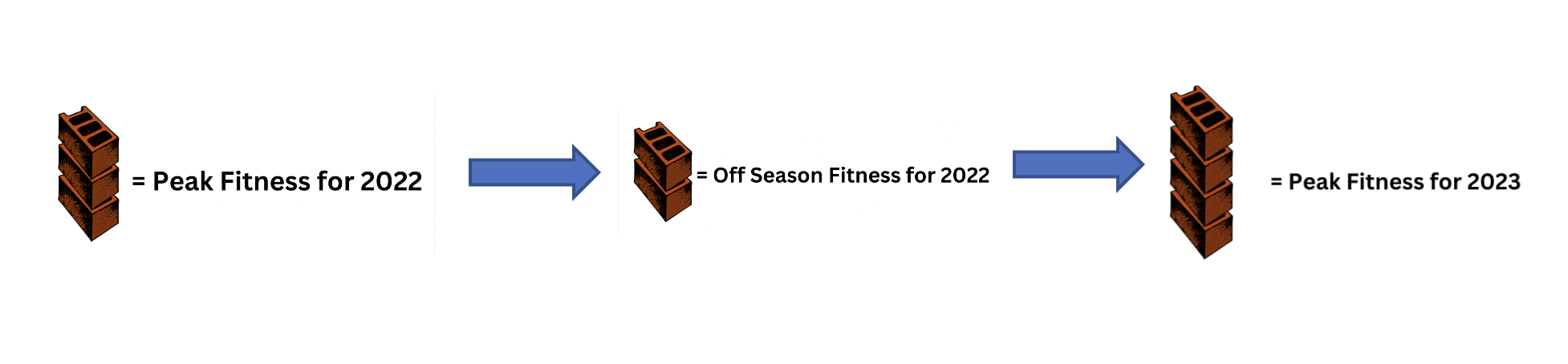
Fitness is Like a Brick Wall: Imagine your fitness is a brick wall. Over the past year of 2022, you’ve worked hard to build your fitness up to a total of 3 bricks strong. This is AWESOME! It’s the most amount of bricks you’ve ever been able to build up to during a season. When you take an off season or a break from running, realistically, you’ll only end up losing about one brick’s worth of fitness. Not too bad, right? Well, this then gives you the ability to build your fitness up to four bricks strong for the 2023 season. You still had the foundation of your two bricks, and better yet, you could build off of that and continue to get more fit than you ever have before. If you’re a visual learner, here’s what I mean:
There’s a bit more nuance to all of this, and of course there are limitations and exceptions, but this is the general idea of why you take rest periods. You will not be starting from 0, but losing a little fitness ultimately helps you gain more fitness in the years to follow.
Running and Self-Worth: To those who really struggle to let go of big training weeks, I find that it’s important for them to look inwards and ask themselves if they’re perhaps putting too much of their self-worth in running. And to those people, I hear you! I’ve been there. In fact, most of my life I’ve been playing various sports and always struggled with putting a lot of my self-worth into athletic outcomes or how much training I was doing. I ultimately figured out that this actually hurt my performance, made it unenjoyable. I would’ve done better if I had just taken the rest when I needed it.
Your self-worth should never be tied to running. Try to find other things that you can do while your body takes its time to rebuild itself. Again, I know this is easier said than done. But, I was somebody who always put my self-worth into sports and couldn’t find happiness somewhere else, but this was just a lie I was telling myself. When I realized this, I was able to find joy in so many things – helping people, being of service, adding quality to other people’s life. This may look different for you, but I truly think there’s always a wide variety of things people are good at and enjoy.