Building an aerobic base is CRUCIAL when trying to boost endurance and achieve peak performance as a runner!
If you’ve been following us for a while, you’ve probably heard us talk about the importance of “building an aerobic base.” For today’s newsletter, Coach Sandi Nypaver explains the science behind what exactly happens to your body when you’re building an aerobic base. Through this, we hope you understand why every runner needs to devote a training block to building theirs!
Let’s get started:
For my runners without a race in the near future, now may be a great time to do an aerobic base phase. During an aerobic base phase, most of your runs will be easy, but you’ll still be making important adaptations.
Adaptation 🥇:
One is the increase in the number and the size of mitochondria you have in your muscle fibers. Mitochondria converts the food we eat. This means they are responsible for turning carbs, fat, and protein into actual, usable energy. The more mitochondria you have, the more energy you can utilize as you run. Mitochondria also help to clear lactate mainly in slow twitch muscle fibers.
Adaptation 🥈:
Another adaptation your body will make during the aerobic base phase is an increase in capillaries. Capillaries are tiny blood vessels that transport blood nutrients and oxygen to cells in your organs and body systems. Increasing the capillaries surrounding your muscle fibers means you can more quickly deliver oxygen and nutrients into your muscles. In other words, your body becomes better or faster at fueling your muscles so they can keep working how you want them to as you run.
Adaptation 🥉:
The third benefit of aerobic based training is an increase in myoglobin, which is a protein that stores oxygen. If oxygen becomes restricted during exercise, myoglobin releases the oxygen to the mitochondria to produce more energy. Another way of putting it is that your myoglobin can serve as your oxygen backup to be used during your race. Easier aerobic running can also strengthen your heart, improve your time to fatigue, and help you better utilize fat as you run.
—————
During an aerobic base phase, the aim is to improve your aerobic system as much as possible before adding in more intense training. If you’re racing anything over a mile, you’re mostly using your aerobic system, which is why aerobic training is so important.
Let’s use a cake as an example. The cake’s icing is your anaerobic system, and the cake itself, so the part made from flour, is your aerobic system. You need both for a good cake, but obviously the cake itself, the aerobic training, makes up most of the cake. The icing, or the anaerobic training, really is the icing on the cake for developing speed.
You still want to add in speed during the aerobic base phase to work on your running economy. I’ll save talking about running economy for another day, but basically adding in things like strides or light fartleks will keep your legs used to running fast during this phase.
In combination with easier running, over time you may see your paces get a little faster while staying at the same effort or heart rate. The short bouts of speed will also help prepare your muscles and tendons for the speed work later on in your training. You can do something like 4-8 x 20 seconds strides every two to three days. Another option is something like strides on Monday and Friday and then have a light fartlek on Wednesday doing 6 x 2 minutes (or something like that).
In conclusion, building an aerobic base isn’t just about improving endurance; it’s about fine-tuning your body for optimal performance. From increasing mitochondria and capillaries to enhancing myoglobin levels, each adaptation works together to make your running more efficient and powerful. So, whether you’re preparing for a race or focusing on long-term fitness, dedicating time to build your aerobic base lays the foundation for success.
Today, Coach Sage Canaday is going to discuss the concept of “running tall,” and why this could make a huge difference in your running form. In short, it will align your whole body position to be able to run efficiently!
The idea with running tall is that we want to avoid the dreaded heel strike. This is when you land in front of your center of mass. When I see runner’s heel strike, it’s often accompanied by “wingy” elbows and their hips are really low to the ground, almost as if they are trying to perform a squat.
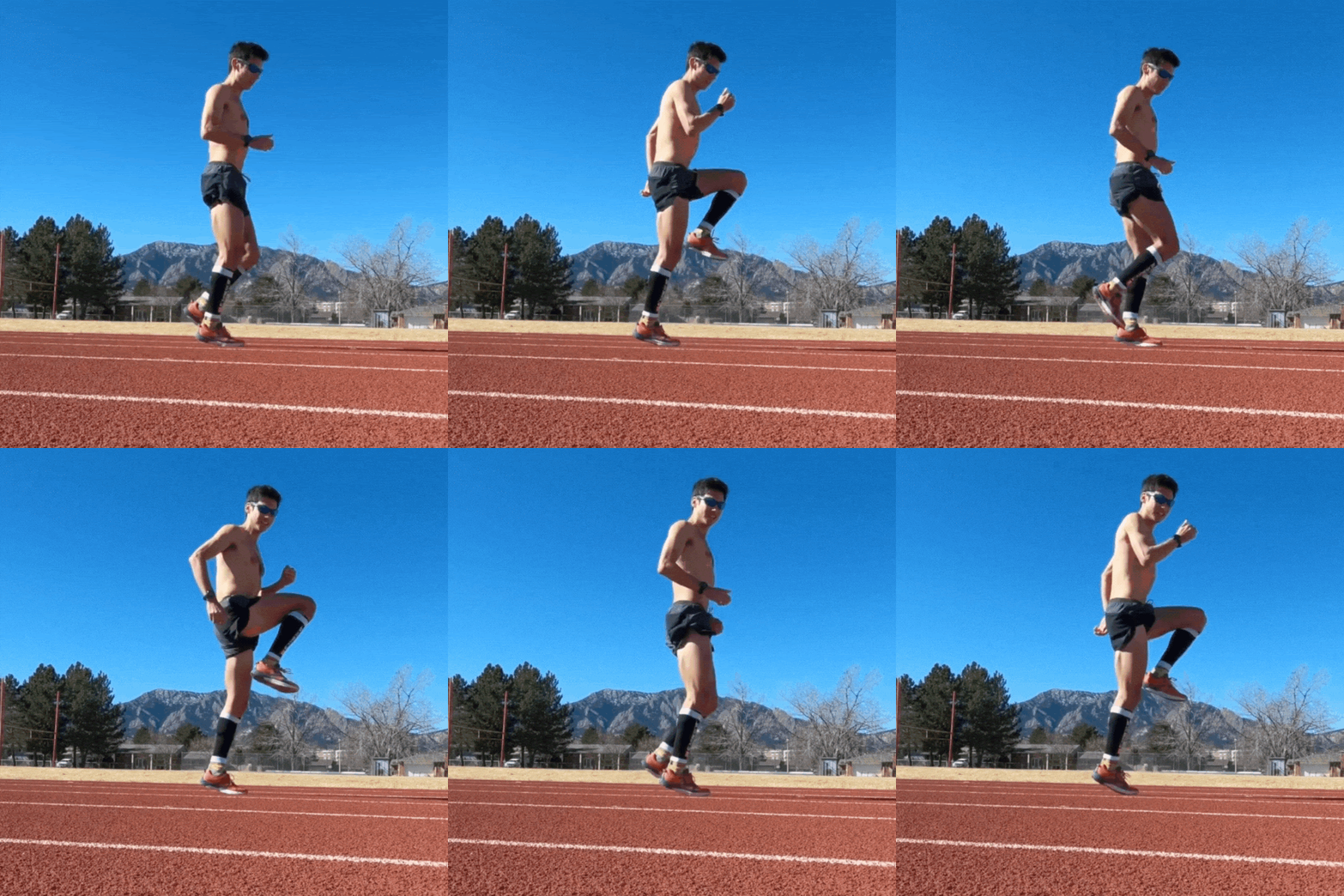
Instead, you want to focus on running tall. That’s the cue for straightening your spine, your whole upper body position, and bouncing off your feet and ankles. One drill that I do to help me with this motion is perform a “running man dance” type of exercise. You can get an idea of that below:
This motion is very exaggerated, but it’s showing the kind of ankle action and propulsion you get when you’re landing under your center of mass off the midfoot or the middle part of your foot (or, at least your whole foot hitting the ground as long as it’s not a heel strike out in front of your body). It’s just better physics; you’re getting more propulsion, more powerful push-off force, utilizing your calf muscles in the back of your legs to your glutes, and springing off the ground.
Another drill to practice is springing up and down, like the exercise you see below. The important thing to note is that I’m straightening the spine while realizing that the forward lean in running comes from the ankles and the feet hitting the ground, and the rest of your body is in line.
Other things to be cognizant of when doing this exercise is you want to be straightening your back and lifting your stomach and rib cage. It opens up your diaphragm so you can breathe better and be more efficient when you run.
So, what’s the point in doing all of these drills and paying close attention to our form?
It’s all about efficiency in running—efficiency to make you run faster but also to minimize the risk of injury from impact force and repetitive strain. There’s a lot of force coming down with each foot strike, two to three times your body weight. If it’s a braking heel strike in front of your body and your hips are too low and you’re running short, like even I kind of do sometimes, then it’s going to put a lot of strain. It could also strain your hip flexors and lower back, causing a lot of pain.
In conclusion, think “run tall” when you’re out running; try to be as tall as possible! It doesn’t mean you’re trying to spring up as much as possible. You still want to avoid too much vertical bounce or oscillation but keep your chest upright, maintain a straight line, and keep your hips under you and up high so you can open up your legs better.
I hope these running form tips and exercises help you a little bit in your running this week. Thanks for your support and happy running!
Sometimes, finding just one good thing can help give us the strength to keep moving forward.
Train your mind to focus on good things.
Coach Sandi Nypaver gives you some of her top tips for when a run gets challenging or a day her going your way. Ultimately, it’s important to ask: Where will you choose to put your focus?
Training your mind to focus on good things can sometimes make the bad days a little easier or help you know when it’s time to start moving on from a bad experience.
Change your perspective.
On bad days we tend to focus on everything that doesn’t make us happy, but finding just on good thing to focus on can start changing our perspectives.
What good things can you focus on when everything seems to suck on the surface?
When it’s raining or snowing, you can appreciate that water is a necessary ingredient for growth. Focus on the important (prevent fires, important to life on earth) of water. Focus on something like how pretty the trees are on your run. Be grateful for the fact that you have a body strong enough to run.
Meditation can be a wonderful tool.
Mediation can be a wonderful tool that can help you stay in the present moment making it easier to focus on all the good things in your life. Meditation is meant to be simple.
Focus on your breathing.
All you do is focus on your breath., feeling the inhale and exhale, and quiet your mind. When thoughts come in (which is expected!), all your do is gently remind yourself to go back to focusing on your breathing. You can do this for a couple minutes or over 20 minutes.
For today’s newsletter, Coach Sandi Nypaver is going to walk you through some of the lessons she’s learned over the years for why it can be helpful to use a race as a training run leading up to your “A” race.
Lesson 1: Mental Toughness 🧠
Racing isn’t just about physical exertion—it’s a mental game, too. By approaching a race as a training run, you’re giving yourself the opportunity to strengthen your mental fortitude. No matter how hard we train when we’re by ourselves, there’s nothing can compare to the mental toughness needed to push your limits during a real race. Embrace the challenge, stay positive, and practice mindfulness both on and off the trails. You’ll be amazed at how this mindset shift can enhance your performance on race day.
Lesson 2: Race-Day Routine Refinement 🏁
Using a race as a training run allows you to fine-tune your race-day routine. From pre-race fueling to post-race recovery, pay attention to what works for your body. Experiment with different nutrition strategies, pacing techniques, and mental preparation rituals. Now is the time to make mistakes and try things out! You do not want to be experimenting with any equipment or nutrition the morning of your race. By the time your goal race rolls around, you’ll have a tried-and-true plan in place for success.
Lesson 3: Physical Limit Exploration 😮💨
Pushing your limits in a race setting can reveal valuable insights about your current fitness level. Racing as a training run gives you the freedom to test your boundaries without the pressure of achieving a specific time or placement. Pay attention to how your body responds to different terrains, distances, and pacing strategies. Use this information to adjust your training plan and set realistic goals for future races.
Lesson 4: Recovery 😴
One of the most important lessons from using a race as a training run is learning to prioritize recovery. Listen to your body and give it the rest and nourishment it needs to bounce back stronger. Whether it’s taking a rest day, incorporating active recovery activities, or simply getting extra sleep, honor your body’s signals and take care of yourself. Remember, recovery is just as crucial as training when it comes to achieving your running goals.
Lesson 5: Perspective and Gratitude 🙏
Finally, racing as a training run reminds us to appreciate the journey as much as the destination. Embrace the opportunity to run alongside fellow athletes, soak in the beauty of the trails or roads, and celebrate every milestone, big or small. Running is about more than just crossing the finish line—it’s about the friendships forged, the challenges overcome, and the moments of pure joy along the way.
So, the next time you’ve identified an “A” race for your schedule, consider adding in a race part way through your training block to help dial in your routines for the big day! Embrace the lessons learned, cherish the experiences gained, and keep chasing those goals. Until next time, happy running!
Coach Sandi Nypaver grew up in the Midwest and has spent the past decade living in Colorado, so she’s no stranger to snow. For today’s newsletter, she’ll discuss the importance of being flexible during your winter training:
When I prepare for races in the Colorado winters, one thing has become abundantly clear: flexibility is key in winter training. While I eagerly await the snowfall, it can sometimes get a bit tricky to schedule my training runs around the weather. It’s not the snow that bothers me; it’s the ice – running on it is an absolute nightmare.
Colorado Weather
In Colorado, our weather patterns can be erratic. We experience intense cold and snow, followed by sudden spikes in temperature during the day and freezing conditions at night. Consequently, our trails often transform into treacherous ice slides, and even our sidewalks aren’t spared.
Despite the challenges, there are moments when winter running here feels magical. However, I’ve come to understand the importance of adaptability. I’ve witnessed fellow athletes pushing themselves relentlessly through the winter grind, driven by a commendable Midwest mentality. But I’ve learned that pushing too hard can lead to burnout and injury. So, while I embrace the Midwestern work ethic, I also recognize the value of listening to my body and adjusting my training accordingly. Flexibility, after all, is the key to thriving in any season.
I have a deep appreciation for “grinding it out,” pushing through regardless of the weather conditions. In the past, I’ve faced blizzards and negative temperatures head-on, determined to maintain my training regimen. However, I’ve learned that there’s a fine line between dedication and burnout.
Burnout Due to Cold Weather
I’ve witnessed this mental exhaustion in myself and in other athletes. By the time spring or summer rolls around, the enthusiasm wanes, and I’m left drained. It’s a cycle I’m keen to break. While I sometimes aim for higher mileage, I’ve come to understand the importance of listening to my body. If the winter proves particularly harsh and running becomes more of a chore than a joy, I allow myself the flexibility to scale back. After all, running should bring fulfillment, not frustration.
This approach aligns with what I advise my athletes: listen to your body’s cues. Progress shouldn’t feel forced; it should come naturally as you find your rhythm and comfort level with your current mileage.
There’s a Balance to Be Found
It’s easy to fall into the trap of setting strict performance benchmarks. However, I’ve learned that true success in running isn’t solely determined by hitting specific mileage targets or completing a set number of speed workouts each week. Instead, it’s about finding a balance that nurtures both physical and mental well-being.
Rushing into things or pushing ourselves too hard can indeed lead to injury or a decline in performance quality. There’s a delicate balance to strike between ambition and patience.
I’ve experienced firsthand the consequences of pushing beyond my body’s limits – from injuries to a decline in form. It’s a scenario I’m eager to avoid repeating. My primary objective is to achieve speed without sacrificing enjoyment along the way. Maintaining that balance is crucial. Even on the toughest days, finding humor and lessons in the struggle can make all the difference. Embracing the journey, rough patches and all, is key. Each obstacle is an opportunity to grow and improve.
I hope this helps you a little bit as we all continue to run through winter, together!