Today, Coach Sage Canaday will be discussing a topic that is of great importance to runners participating in road marathons or half marathons: tackling hills. Whether you’re a seasoned runner or just starting out, understanding the ideal strategy for approaching hills can make a significant difference in your performance. Let’s dive right in!
So, what would be the ideal strategy for tackling a hill in a road marathon or half marathon?
Should you increase the effort and heart rate on the uphill and recover on the following downhill, or maintain a consistent effort and keep the heart rate up the hill? This is a great question that applies to both road and trail running. Keep reading for my full thoughts on these questions!
The Challenge of Hills:
While the focus of this discussion is on road running, it is worth noting that trail running introduces additional variables such as technical terrain and unpredictable weather conditions. However, whether it’s a hilly trail race or a flat road marathon, the fundamental principles of tackling hills remain relevant.
Monitoring Breathing and Perceived Exertion:
The question of whether to increase effort and heart rate on uphill sections or maintain a consistent effort throughout the course is a common dilemma for runners. In road marathon races such as Chicago, Berlin, or Rotterdam, the terrain tends to be predominantly flat and even, allowing for consistent pacing and easier performance monitoring. However, when hills are introduced into the mix, they bring a level of inefficiency to your running.
Rather than relying solely on heart rate data, it can be more effective to pay attention to breathing rate and perceived exertion when tackling hills. Heart rate monitors may not always provide accurate readings, so focusing on how your body feels can guide your effort level. Uphills will increase muscle tension, particularly in the calves and hamstrings, while downhill sections may stress the quads. Adapting your form accordingly can help maintain efficiency.
Running uphill naturally requires you to slow down, leading to an increase in heart rate, breathing rate, and energy expenditure. Unfortunately, the additional effort you put into climbing uphill doesn’t fully recover on the subsequent downhill sections. Unlike riding a bike downhill, where you can catch your breath and relax, running downhill still demands exertion and can put stress on your leg muscles. Thus, the advantage of downhill running doesn’t fully compensate for the time lost on the uphill sections.
Consider the Type of Hill (as well as your strengths and weaknesses):
Therefore, your approach to hills should take into consideration your strengths and weaknesses as a runner, and your training should aim to minimize weaknesses while enhancing your strengths. When facing hills, even if they are relatively small, pacing yourself becomes essential. Let’s take the example of the Boston Marathon, where the Newton Hills between miles 16 and 20 pose significant challenges.
It’s reasonable to expect that you will lose over a minute due to the uphill sections, and it’s unlikely that you will be able to regain all of that time on the subsequent downhills. However, it’s important to note that Boston is a net downhill race overall.
The amount by which you need to slow down on uphill sections depends on your climbing ability and the grade of the hill.
Steeper grades, such as 5% or more, will require a more significant decrease in pace, while a 3% grade might be noticeable but still manageable. In general, when running uphill, it’s advisable not to push your heart rate too high or experience excessive fatigue. Instead, focus on your breathing rate and perceived exertion, as heart rate monitors may not always provide accurate readings.
The Impact of Uphill and Downhill Running:
Running uphill can increase muscle tension in the calves, hamstrings, and quads, while downhill running may stress the quads more. It’s important to adjust your running form accordingly. Swing your arms more when tackling uphill sections to help with momentum, and relax your arms when running downhill. Maintain a slight forward lean from the ankles for both uphill and downhill running, which helps optimize your biomechanics.
Remember that conserving energy and pacing yourself on uphill sections is crucial to avoid depleting your glycogen stores or crossing your lactate threshold, as these can lead to muscle fatigue and cramping.
Especially in marathons, where you have a long distance to cover, hills that appear in the mid to late stages of the race can be particularly challenging.
However, there are exceptions to this general strategy.
If you find yourself at the very end of a race, such as a half marathon or a shorter distance, and encounter a small hill, you might consider sprinting up it. This can provide an advantage if you’re a strong climber or help you create a gap between you and other runners!
The Take Away:
To summarize, the ideal strategy for tackling hills in a road marathon or half marathon involves pacing yourself and consciously slowing down on uphill sections to conserve energy and avoid excessive fatigue. Adjust your effort based on your breathing rate and perceived exertion rather than solely relying on heart rate monitoring.
While you can gain back some time on the downhills, it’s important to acknowledge that hills make the overall course slower and less efficient than a perfectly flat one. Adapt your approach based on your individual strengths, weaknesses, and the specific characteristics of the race course.
I hope this information proves valuable in your training and racing endeavors. Remember, preparation is key, and understanding how to approach hills effectively can set you up for success.
A few weeks ago, Coach Sage Canaday discussed how one can appropriately make the transition from road marathons to ultra-marathons. This week, he thought he’d take it one step further to discuss what an actual training plan would look like for your first ultra-marathon. Understanding key differences is one thing, but what about actually implementing the steps to build a training plan that will yield success?
Let’s dive in to learn more:
Today, we’ll be addressing a popular question I frequently get about the recommended training period for a first-time ultra.
The Norm:
For marathons, I typically advise 16-week training blocks. However, when it comes to a 50K, does it require a longer training period besides increased mileage? This is a great question, and the answer depends on your experience level.
If you’ve completed multiple marathon training blocks and have followed a serious 16-week training plan, you’ll find the transition to a 50K much easier compared to someone who has only run shorter distances like a half marathon or a 10K, without a formal 16-week training plan.
At Higher Running, our training plans generally span 16 weeks for both marathons and ultramarathons, but they cater to different experience levels. If you have years of experience, consistently run high mileage, and race several marathons per year, moving up to a 50K may not be too extreme. Although there are differences in fueling, time on feet during long runs, and the specific type of 50K course, transitioning from a road marathon to a runable 50K is more manageable.
However, if you’re considering a longer ultra like a 100K or 100 miles (160K), and the course involves significant climbing, technical trails, adverse weather conditions, or high altitude, the training timeline might need to be extended beyond 16 weeks. Here’s a little more. on how those differences would work:
What’s Your Running History Like?
Another factor to consider is your training history in the six months leading up to the ultramarathon. Some runners plan their training in longer cycles, not just focusing on 16-week blocks or a few months. They consider a full calendar year or even two years. For instance, when I was a professional road marathon runner, we would plan marathons three times within a two-year cycle. This long-term perspective helps with race logistics, lotteries, and travel arrangements. Your training leading up to the ultramarathon matters, whether you’ve been doing shorter races like an HM and then a marathon, or a marathon followed by an ultramarathon.
If you’ve maintained consistent training over the first six months of the year or during the previous summer and fall, you’ll have a good aerobic base.
If you’ve been running for more than five or ten years and consistently clocking over 50 miles (80K) per week, you have a solid foundation to build upon. In such cases, you can increase your training volume faster with less risk of injury. You could be doing 20-mile (32K) long runs within two to four weeks.
However, it’s important to note that our training plans usually recommend a few weeks of easy mileage and aerobic base running before jumping into specific workouts or long runs. This helps prevent overexertion and injury. Starting from scratch or returning from a long break requires a longer timeline. In these cases, be patient and allocate around 20 to 24 weeks to get in shape for the 50K.
Training Timelines Explained:
Let me also cover the specifics of a 50K ultramarathon and how the training timeline and workouts change compared to a flatter road marathon. As I mentioned earlier, the type of race you signed up for plays a crucial role.
A 50K with 3000 meters of climbing or 10,000 feet of climbing, like the Speedgoat 50K, is more extreme compared to a flat road marathon. Factors like high altitude, technical trails, adverse weather, or humidity can significantly impact your race experience. You’ll need extra time to train specifically for the trail type, terrain, and elevation gain, as it affects your muscle development.
Drawing from my own experiences, I made a mistake when I attempted to qualify for the Olympic Trials in 2016. I had completed a few flat road marathons in 2015 and then decided to take on the Comrades Ultramarathon, which is still a road race, followed by UTMB. It turned out to be too rushed, as the transition to running up and down mountains required more time that I anticipated.
If you lack experience in mountainous or longer ultramarathon races and have mostly focused on road marathons, I recommend allocating more than 16 weeks for training.
Conclusion:
To conclude, the recommended training period for a first-time 50K ultra depends on several variables, including your experience level, genetics, injury resistance, lifestyle, time availability, and gear. Additionally, the type of course and the specific challenge you’re preparing for will influence the timeline. It’s essential to consider all these factors when planning your training for a successful ultramarathon journey.”
Today, Coach Sandi Nypaver wanted to talk about how much runners should stretch, as well as a little bit about mobility.
“I think this has been become a more confusing topic than it should be, but I’ll do my best to walk you through the similarities and differences. I’m applying the best research I’ve seen, and it also includes some thoughts from different physical therapists and sports doctors I’ve worked with.
How it Works For Elite Runners: 🏆Jumping to it when thinking about flexibility for runners — it’s about being flexible in the right places! If you look up a picture or a video of an elite runner who’s actually running fast and get a shot of them from the side. What you’re going to see is a really nice hip extension. However, that same runner might not be able to touch their toes because the back of their legs are so tight.
There may not be enough tightness to cause an injury, because tightness allows for the ideal storage of energy while the leg is on the ground and then the release of energy as the leg is in the air.
The Rubber Band Example: ⭕️It might be helpful for most people to think about different rubber bands:A small, thick rubber band is hard to pull back, so when we do pull it back and release it, it might not go very far. Moreover, a long, skinny rubber band can be pulled back really far, but it’s hard to build a lot of tension. So it also may not go very far!
However, a rubber band that is somewhere in between can be shot much farther. This is a long-winded way of saying that you should stretch anything that could be tight. As a general rule of thumb, stretch your hip flexors and quads. That’s one thing most runners should always stretch. You don’t need to be so flexible that you can stick your foot behind your head.
Let’s Talk Mobility 🤸Okay, let’s go on to mobility now. Having good mobility by doing dynamic stretches could help ensure that all the joints of your body are moving optimally, especially for running. By this point, though, you might be asking, “what’s the difference between flexibility and mobility?”
✅ Flexibility can be summed up as a muscle’s ability to lengthen. ✅ On the other hand, mobility is about a joint’s ability to move through a certain range of motion. Doing a little bit of mobility from the shoulders to the feet can go a long way to help runners stay healthy. Many runners who start doing mobility exercises find that they might be sore the following days because they’re using muscles they haven’t accessed in a long time!
If you also commit to throwing in a hip flexor stretch, quad stretch pretty much daily, that can help you keep a nice long stride that can allow you to get more power from your glutes. Furthermore, a long hip extension can help you increase that elastic energy as you run.
In summary, adding in mobility daily, and then always stretching your hip flexors and whatever else is tight, is a really good part of any running program. Even if it’s just a little bit every day!
That brings up an important note, which is it’s often better to do “mini sessions” throughout the week, rather than doing one long session every week. Personally, I always like to do a little bit of mobility before I run, along with some activation exercises.
Then, if I’m doing another strength training session, I’ll do a little bit more mobility before I do the strength training exercises just to help me. Feel free to do what works best for you but at least you have a picture of how I do it. And with that, this is all I had for this week! I hope this is something you can put into your own running routine.
So you’re trying to decide to take the leap from road running to trail running — that’s amazing! Moving up in distance can be an exciting and challenging experience, but transitioning from a half or full marathon on the road to a 50km or longer trail ultra-marathon requires additional preparation and considerations. Trail running offers unique challenges and rewards, from navigating uneven terrain to taking in breathtaking scenery.
In today’s article, Coach Sage Canaday will share his top 5 tips to help you prepare for your first ultra-marathon and make the transition as smooth as possible. Whether you’re a seasoned runner or new to the sport, these tips will help you stay focused, motivated, and confident as you tackle this new challenge:
“For a little background on myself, I raced 5k, 10K in track in college, and then eventually moved my way up. Maybe you’re in the same boat though. Maybe you’ve started running recently or you’ve gotten back into running and you’ve been doing 5K or 10K road races.
Maybe you’ve been doing dabbling in some half marathons, and now you’re looking to do a marathon and eventually an ultramarathon. The general trend is that you move up in distance as you gain more experience. This newsletter will specifically focus on transitioning from those road half marathons or road marathons.
I have five key tips, for making a successful transition to ultra-marathons, such as the 50K distance, 100k distance, even a hundred miles in the mountains and trails.
Tip Number One:
You have to have a consistent mileage base, which is essentially the aerobic base I frequently refer to. 🫁
For example, instead of running three days a week, you start running five days a week. Instead of running 30 miles a week or 50K a week, maybe you’ve started to average 50 miles a week or 80K a week. That kind of base generally really helps you in long distance racing! If you’ve got that consistency of just getting out the door, hitting those weekly mileage totals, spending time on your feet, training the aerobic system, even at relatively low intensity, it’s gonna set you up really well for doing an ultramarathon.
Now let’s briefly look at the physiology in terms of stressing your heart and lungs. A 50K is really just a minor extension off of a marathon, right? As long as it’s not a super high-altitude race or something really technical, it hopefully won’t feel too different than a regular marathon. A 50K should be very doable if you’ve gotten in consistent mileage base and experience in marathon training, so it probably best to start off with a 50K and see how your body responds.
Tip Number Two:
Add in hills or vertical. 📈
Not all ultra-marathons are going to be flat. In fact, most won’t be! Because there’s going to be a lot of vertical gain (at least more than what you’re used to in a regular road marathon), it’s critical to prepare your legs for that pounding of downhills and climbing strength for uphills.
To run strong uphill, it’s important to build overall strength and get that type of cardiovascular benefits for your heart and lungs. In a lot of our Higher Running Training Plans for Mountain Ultra training plans, we do have workouts like high intensity, short hill repeats, or have you do all uphill tempo runs or treadmill works where you’re adding in vertical gain and up relatively steep grades.
We’re talking 5% grade, 10% grade, even 20% grade. If you’re going to be training for a mountain race, you need to get used to that change in vertical. To take this one step further, add in hills and add in some long runs that are rolling that mimic the profile of the course. Your legs will get really strong doing this. Your heart and lungs get better with these specific types of aerobic adaptations.
Tip Number Three:
Throw your time and splits out the window. ⏱🚫
Unless you’re running a 50K on a track or you’re doing a really flat, non-technical ultramarathon race, you’re probably going to have no idea in your first ultra what kind of relative pace you might hold. For example, we have a lot of people that run sub-3-hour marathon in the roads. They run the Boston Marathon, and they’re fast on the roads. Then, all of a sudden, you throw them out on the trails and they’re splitting four or five hours for a 50K. Letting go of your expectations will help you enjoy the race more and get a better understanding of how you respond to longer races.
For me personally, I’m frequently slogging 10–15-minute miles. I’ve even done races where I’m power hiking up a mountain at 25-minute mile pace (18-minute km pace). It’s not like road running or flat, fast track running. Throw times out the window, you have to go by effort.
Tip Number Four:
Ultra-marathons require their own, specific long runs. 💪
Long runs are the bread and butter of a lot of our marathon and ultramarathon training plans at Higher Running. Try to build your long runs off what the actual course is going to be. Take the time to do your due diligence and research the types of trails it’s on, how much total vertical the race has, etc.
One you’ve done this, try to mimic that in some of your long runs. Now, obviously, you’re not going to go out and run a 50K ultra when training for a 50K. But you might be doing a 20-mile long run (32km) as part of your regular training, and it’s important you’re mimicking the terrain you’ll be racing on.
And like I said in the previous tip of throwing your time goes out the window, you might just be looking to spend time on your feet. Go out on the weekend (or whenever you have more time to actually train on trails) and you say, “okay, I’m going to do a four hour long run.” Or, “I’m going to spend half the afternoon out on the trails.”
Tip Number Five:
Ultra-marathons require specific nutrition and gear. 🍌
This is something you’re going have to figure that out, because everyone is different!
However, I can briefly address the basics:
Nutrition: You need to have probably more calories on you. Some people use hydration packs, whereas others rely on aid stations. Research what’s at the aid stations, practice your fueling strategy, and dial in what works best for you.
Gear: You’re spending more time out in the elements. You’ll have to have all types of jackets, extra shoes, extra socks, etc. You could get more extreme temperature changes as well. But it depends on where your ultramarathon race is and how long it will take you.
Moving up in distance from a road marathon to a trail ultra-marathon can be a daunting task, but with the right preparation and mindset, it can be an incredibly rewarding experience. Remember to focus on your training, stay motivated, and be patient with yourself as you adjust to the unique challenges of trail running. With these tips and your own determination, you’ll be well on your way to achieving your trail ultra-marathon goals.
Engaging your muscles fully and preventing constant tightness is essential to maximize your performance and reduce the risk of injury. Coach Sandi Nypaver will be sharing her expertise on the three key ingredients to an effective warm-up routine that will not only prepare your body for exercise but also improve your overall mobility and flexibility. So, whether you’re a seasoned athlete or just starting out, keep reading to learn how you can take your warm-up routine to the next level!
Step #1: Active Release and Foam Rolling
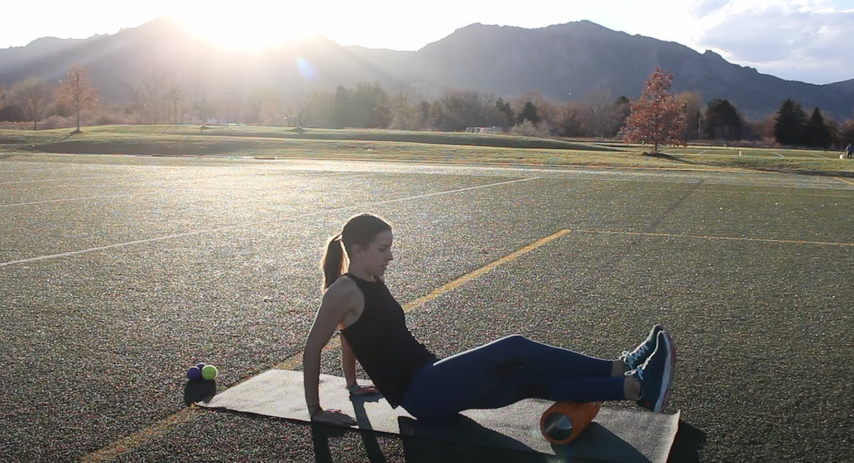
The first step to a proper warmup routine is foam rolling or doing some type of active release. This is often something athletes think they should do post-run, or just remember they can fit it in, but the benefits may be short-lived when done alone.
Current research has shown people can get lasting benefits if they foam roll right before mobility exercise. Think of it this way: if there’s a knot in a rope, you can pull the rope all you want, but it’s not going to reach its full length until the knot is removed. Foam rolling and active release aids in getting rid of the tight muscles and promotes good fascial movement so that you can get a better range of motion during your mobility exercises.
To be realistic, if you’re short on time and nothing feels tight, then I do believe it’s sometimes okay to jump right into mobility. However, I strongly believe in the benefits of consistent foam rolling and active release sessions to keep runners mobile and healthy. Many runners have no idea how tight certain muscles are until issues arise.
Step #2: Mobility
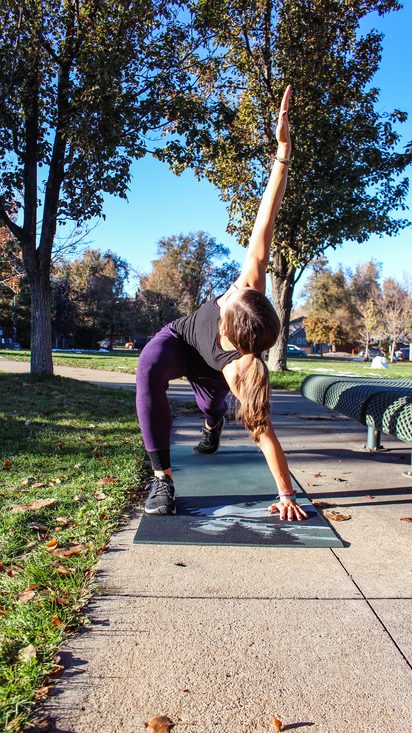
Let’s move on to the second key ingredient, mobility. Mobility is the joint’s ability to move through a range of motion. In other words, doing mobility before a strength session or a run reminds your body to move through its full range of motion instead of staying in a shortened state. Think of it this way, if you just sat at a desk all day, your hip flexors are used to being in a shortened state and your glutes are used to being turned off.
Doing hip mobility would remind your hip flexors on how to lengthen while waking up your glutes. The same goes for sitting in a hunched position for long hours. Doing a little thoracic mobility can open up your chest and allow for a proper counter rotation to your lower body as you run. When runners lose thoracic mobility, they may try to get the counter rotation from their low backs instead. Proper mobility as you run can help you better absorb impact forces while simultaneously allowing you to create more force or allowing you to get more power from your muscles.
Step #3: Activation
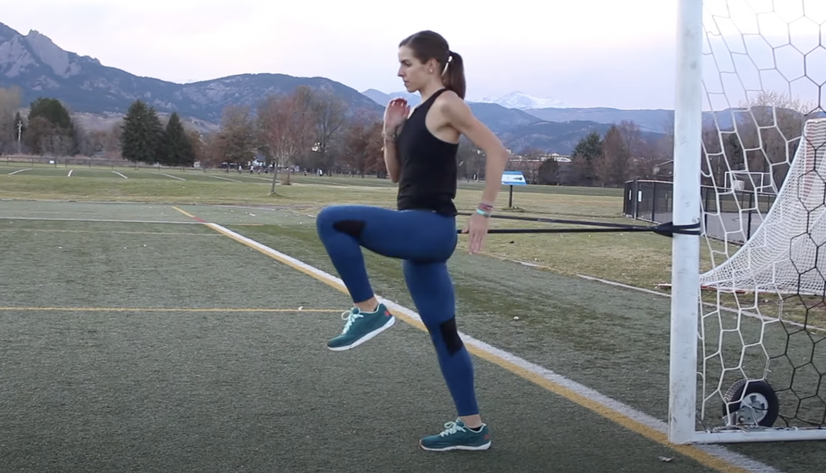
Now let’s tie an active release and mobility with a third key ingredient: activation. Since you took a couple of minutes of foam roll and did some mobility exercises, you can now get the full benefits of your activation exercises because you can fully access the muscles you’re targeting. In turn, this can help prevent chronic tightness. For example, if your hip flexors are chronically tight, when your glutes are engaged, your hip flexors will lengthen as you move. So, your hip flexors are no longer in a chronically shortened state which caused the chronic tight.
The crucial factor with any activation exercise is to make sure you are using the muscles you’re supposed to be using. That mind body connection is essential, especially as you start your run or strength workout. It is entirely possible to look like you’re doing a glute bridge, but not feel your glutes working at all.
That’s not what you want. If you can’t feel the right muscles working, you may need to do a little more active release and then start off with simpler exercises in smaller movements. Different people need to work on different things. But with my experiences as a running coach, my practical advice would be to spend the first couple minutes of your warmup routine, aiming to create good fascial movement and relax the tight muscles.
Next, do a hip thoracic spine and ankle mobility exercise. Lastly, pick a couple of activation exercises to target your different gluteal and hip muscles. Yes, there are exercises that double as both mobility and activation exercises, like a lunge with a side rotation.In conclusion, a proper warmup routine that includes foam rolling or active release, mobility exercises, and targeted muscle activation is critical for preventing injury and optimizing performance. By investing just a few minutes in a comprehensive warmup, you can effectively prepare your body for the physical demands of your workout or competition. So, take the time to engage your muscles fully, relax any tight areas, and prime your body for success. Incorporating these three key warmup ingredients into your routine can help you become a stronger and faster athlete.