Whether you’re a runner who likes to dabble in triathlon, a pure triathlete looking to up your running game, or someone who likes to switch things up every once in a while,
Coach Sage Canaday is going to explore how many hard training days an athlete can have per week between cycling and running.
As for the swimming part… well, we won’t really worry about that today 😂
This is a fun question for me to tackle. First disclaimer here, I am obviously not a triathlete. I have done a sprint triathlon in high school, but I’m not very good at swimming!
Considering it from a scientific, muscular, and stress-related perspective, and drawing from insights into the training routines of professional triathletes, I’d suggest one of the primary factors to first consider is whether you’re preparing for an Olympic distance triathlon or something longer like a half Ironman or Ironman distance triathlon.
The balance between high-intensity workouts and longer, endurance-focused sessions, such as extended bike rides and runs, may vary slightly depending on the distance you’re training for. The duration of your training period for a specific race type—whether it’s Olympic distance or sprint distance—might also influence the intensity of your training regimen.
Certainly, numerous factors come into play, including your pace, background, and personal experiences. Whether you began as a runner and ventured into cycling and swimming or vice versa, you’re juggling multiple disciplines—swimming, cycling, and running. It’s a complex balancing act, influenced by the time you can allocate for training and the resources at your disposal.
As your events approach, it’s essential to adapt your training blocks to address any weaknesses. For instance, early in the season, prioritize biking if it’s an area that needs improvement. When focusing on running, incorporate high-intensity sessions to make the most of your training efforts. Remember, endurance events demand superb aerobic fitness and proper hydration, so emphasize improving heart and lung efficiency while ensuring you stay well-hydrated.
Including tempo runs or longer intervals, like 2×3 miles or 2x5k at threshold pace, can prove beneficial. However, it’s crucial to be cautious when combining intense biking with running. The strain from biking, particularly during uphill climbs, can fatigue muscle fibers, potentially affecting subsequent running workouts, especially speed sessions. Thus, finding the right balance between biking and running intensity is vital for optimizing your training regimen.
While training intensely all the time isn’t enjoyable (or recommended), the low-impact nature of cycling and swimming allows for higher volume and more frequent training compared to running.
Often, when scheduling long runs or long bike rides, there’s some aspect of pace changes, vertical gain, or pushing yourself when you’re really tired. But, as I said, it’s not set in stone every week. Some weeks will require more recovery, lower volume, and maybe no hard workouts. Other weeks, you might be able to hit it with three quality workouts spread out over the week.
So, there are numerous variables to consider when training for a triathlon, including discipline balance, intensity, and recovery, and the ultimate goal is to optimize performance while minimizing the risk of burnout or injury. Tailoring your training plan to fit your individual needs, incorporating a mix of high-intensity sessions and longer endurance efforts, and allowing for adequate recovery time are key components of a successful triathlon preparation. By understanding your own limits, listening to your body, and remaining adaptable to changes in your training schedule, you can work towards achieving your endurance goals effectively. Remember, consistency, patience, and a balanced approach are paramount for success.
Even though it certainly isn’t as enjoyable as running outdoors, there are ways to make it better. For today’s newsletter, Coach Sage Canaday takes you through some of his top tips that help him push through those tough treadmill sessions.
Hey there, it’s Coach Sage Canaday! For today’s newsletter, I wanted to touch on some insights when it comes to treadmill running. I’ll first dive into some tips and tricks to make your indoor runs more enjoyable and effective, and then some differences between running outdoors versus on a treadmill. First off, let’s acknowledge that having a treadmill is a luxury. While there are advantages to treadmill running, such as controlled conditions and pacing, there are also some drawbacks. One of the biggest challenges is the monotony of running in one spot, especially if you’re confined to a basement like I often find myself.
Tip #1:
My first tip? Position your treadmill near a window if possible. Watching the world outside, even if it’s just people walking by or cars passing, can help stave off boredom and provide a mental escape.
Tip #2:
Now, onto distractions. Some folks opt for TV or Zwift for visual stimulation, but personally, I prefer music. I pop in my earbuds, queue up a killer playlist, and zone out to the beat. It’s a great way to stay motivated and engaged during your run.
Tip #3:
Don’t forget your towel! Sure, it’s handy for wiping away sweat, but I also use mine to cover the treadmill screen. Constantly staring at the clock or distance can make time drag, so I prefer to cover it up and focus on my music and stride instead.
Tip #4:
Lastly, let’s talk temperature. If you’re running in a gym, you might not have control over the climate, but if possible, aim for a cool environment. Running in a hot, stuffy room can make your workout feel even more grueling. One key element that’s often overlooked is temperature regulation. Sure, you could crank up the AC, but what you really want, and what some treadmills offer, is a fan. Trust me, you’re going to get hot. Really hot. Positioning a fan strategically can make a world of difference. Ideally, you want it blowing at chest to neck level, providing a steady stream of airflow to keep you cool and comfortable.
Speaking of staying cool, don’t be afraid to go shirtless if it helps regulate your body temperature. With a heart rate monitor already in place for tracking your data, shedding that extra layer can enhance airflow and comfort during your run.
Treadmill Versus Outdoor Running:
Now, let’s shift gears and discuss the differences between treadmill running and outdoor running. One major distinction is the absence of wind resistance on a treadmill. Unlike running outdoors where you’re battling against air resistance, treadmill running occurs in still conditions. This means that running at a set pace on the treadmill can feel easier due to the lack of external resistance. So, while you may be cruising at a six-minute mile pace indoors, keep in mind that you’re not facing the same level of resistance as you would be outdoors, where wind resistance can significantly impact your effort. Understanding these differences can help you adjust your training and pacing accordingly, especially as you push the limits of your speed and endurance. So next time you’re pounding away on the treadmill, keep these insights in mind to optimize your performance and enjoyment.
It’s also important to discuss how the nature of the treadmill belt affects your form and how you can adjust for a more realistic outdoor running experience. Running on a treadmill certainly alters your running form. The moving belt means you don’t have to push off quite as hard, which can subtly change your stride mechanics. You might find yourself constantly adjusting to the moving surface, worrying about maintaining your balance, or avoiding running off the sides. These factors can lead to a different feel compared to outdoor running and may even make it feel like you’re expending more effort, despite the lack of wind resistance indoors. Additionally, distractions like adjusting music or fiddling with hand controls can further impact your form and focus.
However, many runners opt to adjust the treadmill incline to mimic outdoor running conditions more closely. Setting a slight gradient, typically around 1 percent, can help compensate for the lack of wind resistance and better simulate the effort required outdoors. Keep in mind that this adjustment can also alter your running form, as you’ll be engaging different muscle groups on the incline.
Another notable difference is the ability to lock into a steady pace on the treadmill. Unlike outdoor running where pace fluctuations are common, treadmill running often involves maintaining a consistent speed. While this can be beneficial for specific training goals, it can also lead to added stress if you’re constantly monitoring your pace and heart rate.
Lastly, it’s important to remember that not all treadmills are created equal. Accuracy can vary widely between models, and factors like calibration and belt condition can affect the readings displayed. If you’re relying on treadmill data for training purposes, consider using additional tools like foot pods for more accurate distance tracking.
So, the next time you hop on the treadmill, keep these insights in mind to optimize your form, simulate outdoor conditions, and make the most of your indoor runs. And don’t forget to stay flexible with your training approach, adjusting as needed based on the unique challenges and benefits of treadmill running. Happy trails, whether they’re indoors or out!
Coach Sandi Nypaver grew up in the Midwest and has spent the past decade living in Colorado, so she’s no stranger to snow. For today’s newsletter, she’ll discuss the importance of being flexible during your winter training:
When I prepare for races in the Colorado winters, one thing has become abundantly clear: flexibility is key in winter training. While I eagerly await the snowfall, it can sometimes get a bit tricky to schedule my training runs around the weather. It’s not the snow that bothers me; it’s the ice – running on it is an absolute nightmare.
Colorado Weather
In Colorado, our weather patterns can be erratic. We experience intense cold and snow, followed by sudden spikes in temperature during the day and freezing conditions at night. Consequently, our trails often transform into treacherous ice slides, and even our sidewalks aren’t spared.
Despite the challenges, there are moments when winter running here feels magical. However, I’ve come to understand the importance of adaptability. I’ve witnessed fellow athletes pushing themselves relentlessly through the winter grind, driven by a commendable Midwest mentality. But I’ve learned that pushing too hard can lead to burnout and injury. So, while I embrace the Midwestern work ethic, I also recognize the value of listening to my body and adjusting my training accordingly. Flexibility, after all, is the key to thriving in any season.
I have a deep appreciation for “grinding it out,” pushing through regardless of the weather conditions. In the past, I’ve faced blizzards and negative temperatures head-on, determined to maintain my training regimen. However, I’ve learned that there’s a fine line between dedication and burnout.
Burnout Due to Cold Weather
I’ve witnessed this mental exhaustion in myself and in other athletes. By the time spring or summer rolls around, the enthusiasm wanes, and I’m left drained. It’s a cycle I’m keen to break. While I sometimes aim for higher mileage, I’ve come to understand the importance of listening to my body. If the winter proves particularly harsh and running becomes more of a chore than a joy, I allow myself the flexibility to scale back. After all, running should bring fulfillment, not frustration.
This approach aligns with what I advise my athletes: listen to your body’s cues. Progress shouldn’t feel forced; it should come naturally as you find your rhythm and comfort level with your current mileage.
There’s a Balance to Be Found
It’s easy to fall into the trap of setting strict performance benchmarks. However, I’ve learned that true success in running isn’t solely determined by hitting specific mileage targets or completing a set number of speed workouts each week. Instead, it’s about finding a balance that nurtures both physical and mental well-being.
Rushing into things or pushing ourselves too hard can indeed lead to injury or a decline in performance quality. There’s a delicate balance to strike between ambition and patience.
I’ve experienced firsthand the consequences of pushing beyond my body’s limits – from injuries to a decline in form. It’s a scenario I’m eager to avoid repeating. My primary objective is to achieve speed without sacrificing enjoyment along the way. Maintaining that balance is crucial. Even on the toughest days, finding humor and lessons in the struggle can make all the difference. Embracing the journey, rough patches and all, is key. Each obstacle is an opportunity to grow and improve.
I hope this helps you a little bit as we all continue to run through winter, together!
Coach Sage Canaday weighs in on when you should start incorporating double run days into your training schedule:
Today, I’ll be exploring when it makes sense to start running twice a day and incorporating ‘doubles’ into your training program. This is a common question I face as a coach, both with those I coach and from what I see on various online forums. The general rule is that for most people with busy schedules including work and family commitments, finding time to train efficiently is crucial. Running twice a day may not be feasible for most individuals due to time constraints. Another important factor to consider besides time is your weekly mileage.
When It’s Time to Do Doubles
If you’re consistently running over 60 miles a week, perhaps even reaching 70 miles, then it might be time to consider incorporating double run days into your schedule. This is a point we emphasize in our Higher Running programs; as your weekly mileage increases, adding doubles becomes more beneficial.
Incorporating double runs into your training regimen can enable you to achieve higher weekly mileage without increasing stress on your body. For instance, splitting your mileage into two sessions, such as 6 miles in the morning and 6 miles in the evening, can be gentler on your joints compared to running the entire distance at once.
When It Makes Sense to Do Singles
However, if your weekly mileage is below 60 or 70 miles, which is likely the case for many individuals, particularly those training for longer distance events like half marathons or beyond, you may derive more aerobic benefits from completing one continuous run. In this scenario, a single 10-mile aerobic run could provide a more effective training stimulus compared to splitting the distance into two sessions.
So, when considering the singles versus doubles debate, opting for a longer, continuous run may be more efficient in terms of maximizing aerobic gains. Plus, it eliminates the need for an extra shower!
In coaching literature like Mark Wetmore’s work with University of Colorado’s athletes, there’s a notable emphasis on high-mileage single runs. Athletes like Adam Goucher maintained a daily average of 14.3 miles, totaling a hundred miles per week. However, sustaining such high mileage solely through singles can be physically taxing. Wetmore’s rationale, as seen in later interviews, revolves around efficiency. By running once a day with occasional longer runs and easier recovery days, athletes can reach a hundred miles weekly with reduced exhaustion and risk of injury.
For many, doubling may not be time-efficient. However, it’s a valuable strategy for achieving peak weekly mileage without escalating the risk of overtraining or injury. Doubling allows you to distribute the workload effectively, making it easier to accumulate miles while minimizing strain.
My Personal Experience
For instance, during periods of easy mileage, like when I was running 125 miles a week, averaging 18 miles per day, doubling proved instrumental in maintaining consistency and minimizing fatigue.
To optimize my training routine, I typically ran 10 or 12 miles in the morning, followed by a rest period, and then completed a 6-mile run in the evening. This approach allowed me to break up the mileage rather than facing the daunting prospect of tackling 18 miles all at once on my easy recovery days. While long runs are essential and are included in my schedule, splitting the mileage into two sessions proved gentler on my joints, facilitating recovery while still achieving my mileage goals.
Moreover, doubling up provides a metabolic boost. By revving up the system earlier and later in the day, you maintain a steady energy flow and enhance fat burning between workouts. It’s akin to the effect of weightlifting, where your metabolism remains elevated post-workout, contributing to overall calorie expenditure and fitness gains.
So unless you’re consistently running over 60 miles a week or rapidly increasing your mileage and prioritize injury prevention or enhanced recovery, running twice a day might not offer significant efficiency gains. It’s crucial to tailor your training approach to your individual goals, fitness level, and recovery needs.
I wanted to share something that happened to me a few years back, where I found myself in a bit of a predicament at the beginning of the 2022 running season.
I had already known which races I wanted to do for a while but couldn’t bring myself to sign up. That’s because there was something I wasn’t feeling good about. Personally, I think it’s so important to align and then act, at least when I can. It’s something I’ve always tried to practice, and I’m still working on it to this day! It doesn’t come easily because, if I’m being honest, this feeling of being “out of alignment” with the races I wanted to do probably lasted a few weeks before I took the moment to acknowledge it. That’s why I wasn’t signing up, even though I had planned to.
Finally, one week, I sat down and took a moment to think about why I wasn’t feeling good about the races anymore. And then, this is the important part, I took out my notebook and pen, and I wrote down two very important things:
1. How I wanted to feel about the race
2. how I wanted to think about the race.
And doing that created a huge shift for me.
Sometimes these shifts take time. This shift was actually pretty fast because I took that moment to align. This is stuff I know; when you’re feeling bad about something, it’s important to acknowledge it. I wasn’t feeling that bad, but it just wasn’t where I wanted to be feeling.
Take a moment to acknowledge when you’re not feeling great, to acknowledge why, and then think about how you want to be thinking about a situation. That’s such a guidepost for me, and I hope it is for everybody. Our feelings are so important, so we shouldn’t just go through the motions, but instead, take a moment to reflect on this misalignment.
And I’m obviously not perfect!
It took me a few weeks to get there, but I did. You can’t beat yourself up about not doing things as soon as you should because constantly learning, and the fact that I did take the moment and sat myself down was huge. Who cares if it took a few weeks?
I did it. I felt better. I got that shift, and I was able to sign up for the races. And most importantly, as soon as I did that, I noticed that all my runs felt a little bit lighter. I was able to get that joy feeling, especially going uphill or sending a downhill. Like running, it instantly became more fun because I was back in alignment with how I wanted to feel about racing and running.
Here’s my takeaway for you: it’s essential to listen to our inner voice and acknowledge when something isn’t quite right. Taking the time to realign ourselves with our true desires and goals can lead to profound shifts and a renewed sense of joy. While it may take time to get there, the important thing is that we make the effort and take the necessary steps towards alignment. So, let’s remember to be patient with ourselves, embrace the learning process, and prioritize our well-being and authenticity in our journey as runners and individuals.
These are some practical tips for navigating the trail safely, effectively, and efficiently, aiming to minimize the risk of tripping and falling while conserving energy for those challenging mountain trails:
Tip #1: Your ArmsIf you’re looking to increase your downhill speed, let’s dive into the technical sections. Firstly, your arm movement is crucial. It won’t be a typical, uniform arm swing. You need to counteract the balance and side-to-side motion of your momentum and weight with your arms. Feel free to swing them wide and high! Use your arms to balance as your legs navigate the technical rocks, requiring them to move from side to side. Imagine yourself flying and utilize wide arm swings, almost like a windmill.
Tip #2: Light, Quick StepsTip number two emphasizes the importance of taking small, quick steps while navigating downhill trails. Your stride rate could surpass 200 steps per minute, especially when speeding down a technical trail. To effectively maneuver the terrain, envision yourself dancing with it—employ quick, light footwork. Constantly remind yourself: “quick feet, quick feet.” It’s better to err on the side of shorter steps rather than attempting to jump across a gap. Avoid overreaching and overstriding, which could lead to potential missteps on rocks. Instead, opt for quick, stutter steps between technical obstacles.
The advantage of these quick, light steps is twofold. Firstly, they reduce the likelihood of heel striking. Landing with your body mass centered and maintaining a slight forward lean, ideally perpendicular to the downhill slope, ensures better control. Secondly, landing with less force minimizes the risk of tripping and falling. In the unfortunate event of turning an ankle, the reduced force behind the landing mitigates the impact and helps you maintain better overall control on the descent.
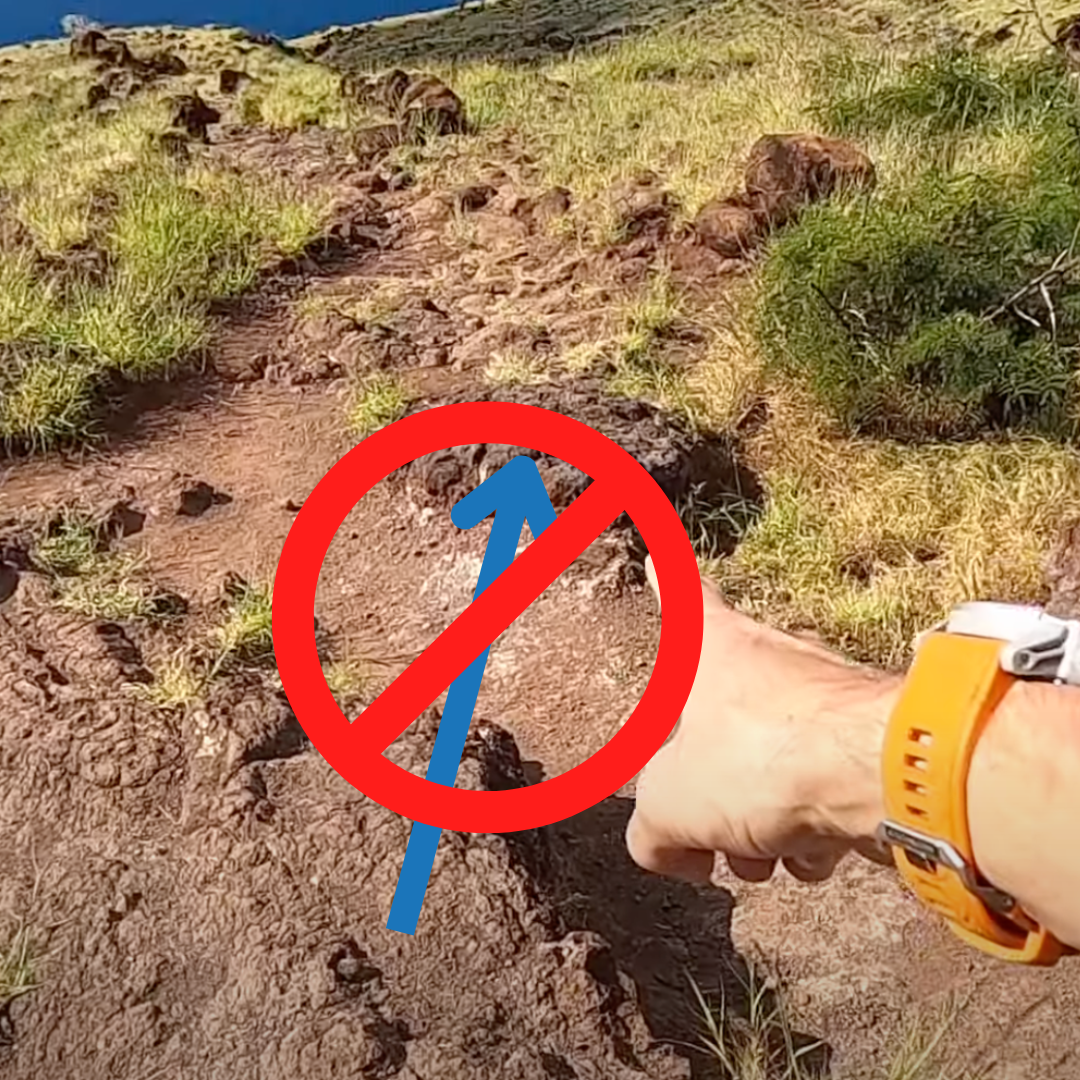
Tip #3: Line SelectionThe third and final tip for today emphasizes the importance of selecting your trail line wisely. When faced with undulating terrain, consider weaving from side to side rather than attempting a straight path. Negotiating a series of controlled turns, almost like slaloming in skiing, is often a safer and more efficient strategy than tackling large jumps or trying to go straight across. Here’s what I mean by that:
On first glance, it might make sense to jump from one rock to the other, because it’s the most direct path. But this gap could be dangerous with even the slightest misstep!If I go this way, I’m going with the turns and can maintain more control as I run with the curvatures in the trail.
Imagine yourself riding a mountain bike or skiing down similar slopes; having the ability to control your trajectory from side to side not only helps manage speed but also allows you to choose the optimal path. Opting for a controlled descent with slight side-to-side movements is less risky than attempting large jumps to cut off distance.
In this approach, it’s crucial to maintain a forward-looking perspective. Look ahead, scanning the ground at least 10 to 15 feet in front of you, anticipating your next several steps. By doing so, you can plan where to plant your feet and strategically pick your line down the slope to avoid obstacles. Drawing from experiences in activities like mountain biking, skiing, or other sports provides valuable insight into the art of picking the best line as you navigate downhill slopes.
Thank you for tuning in to this brief tutorial on downhill technical trail running tips. If you found this information helpful, be sure to explore our website, HigherRunning.com, where you can find even more FREE and helpful running resources. Happy running,- Sage Canaday