Today, we wanted to talk you through some of our most common questions we get about training as well as our own training plans.When you don’t have one-on-one coaching, it’s not always easy knowing what to do in instances of sickness, missing a workout, or having to adapt a training plan. Hopefully these answers will help guide you in your training!
Note: This is a longer read, so we’ve highlighted the questions in red, so you can skim for something you’ve always wondered yourself.
Q: What do I do if I get a 16-week training plan, but I only have 13 or 14 weeks until the race?
A: This partially depends on your overall fitness level. If you already feel like you have a good base and you don’t need a base, just remove the first couple of weeks. For most of our training plans, the first couple of weeks are focused on easier mileage, with maybe a lighter workout every couple of days. This is more so to prepare you for the weeks to come and make sure you have the base needed to really thrive using the training plan.
Now, say you feel like you don’t have a good base and you need those first couple of weeks to build your aerobic base back up. Our suggestion would be to look at the plan, ask yourself what you feel like are your running strengths (e.g., good at long, sustained tempo work), then ask yourself what week of the training plan would best suit your strengths, and those are the weeks that you could look at skipping. Focus on the weeks that are addressing your weaknesses that you feel like you need to work on.
It’s important to understand that with a question like this, there’s a lot of individual variables at play, such as the aforementioned aerobic base and your strengths and weaknesses as a runner. For Higher Running training plans, we usually try to help you feel as ready for the training plan as possible by showing you the prerequisites even before you purchase the plan (e.g., To use this plan, we suggest you’ve comfortably been running 25-30 miles per week all easy pace to be able to handle the volume). Don’t feel like you have to follow the training plan exactly to a tee, as they’re designed to be flexible, but these are all things to consider when trying to complete the training plan in a shorter amount of time.
Q: My main goal is to race a 100km race at the end of my 16-week training plan, but I also want to do a 50km race halfway through the training plan. What should I do in that situation?
(Or in situations where I have a B race halfway through training for my A race – choose you distances of choice)
A: We get this question a lot, and our thought is that even after a 50km, you’ll have to take recovery seriously. This means the week after the 50km you’re going to have to take it easy. You shouldn’t worry about the workouts or prescribed mileage, as you might not even run for most of the week. If you do run, focus on easy mileage. Then, your 2nd week post 50km, this is where you have to know yourself and be honest how you’re feeling. Some people may be able to jump in right where they left off. Others may still need to take it easy or reduce the volume of both the workouts and prescribed mileage.
You have to be really careful in the recovery and honest with yourself. Did you race this super hard and it’s going to result in 2-3 weeks of residual fatigue? It’s important to ask yourself what your true goal is, so if the 100km is your A goal, and the 50km is more of the “tune up” race, you could just use the race as a training effort like a long-run workout. (But it will still be a super hard workout regardless). Ultimately, don’t set expectations what you want your training to look like for the next 1-2 weeks post 50km race. Don’t try to push through the pain because you think it’ll help, because it will most likely end up hurting your 100km performance if you start things up too quickly again.
Q: If I get injured somewhere in the middle of a training plan, how do I come back? Do I start from zero? Do I jump in right where I left off?
A: This is going to vary from person-to-person and injury-to-injury. If you’re injured for a long time (several weeks), you’ll probably have to start from the beginning or even take a couple of weeks to even start truly training again. However, if you only have to take only a couple of days off, you might be able to jump in where you left off. Say you take off Monday, Tuesday, Wednesday and feel good enough to run Thursday, you can probably treat it as an easy to moderate run and reduce the volume of the run. Then for the next couple of days you still would reduce the volume and intensity of the run/workout.
Q: Okay, that makes sense about injury, but what about getting sick?!
A: This will vary depending on the sickness. If it’s just a cold and you have to take a day or two off, don’t worry about losing too much fitness. If it’s something more serious like the flu and you have to take a week or more off, you will probably have to ease back into things with reduced run volume and intensity. Depending on when the sickness or injury occurs, you could also just do an extended taper leading up to the race if your cautious and being honest with yourself.
All in all, if you happen to miss a few workouts or runs because of injury, sickness, or even life, it’s not going to totally derail your training. Yes, it might take you a couple of days to get back into the swing of things, but we’ve actually seen a lot of people improve significantly after a few extra days off because of the rest their body needed.
Q: Should I be weightlifting? If so, how would I incorporate this into my run?
A: There can be a lot of different approaches to this, but we can tell you what we typically do.
We like to do our strength/lifting sessions the same day as a speed workout. The optimal way to do it would be to first do the hard run, and then the weightlifting session later on in the same day. This way you’re keeping your hard days hard, and easy days easy.
Other programs say to fit in the weight training when you can, no matter where it falls. Again, we don’t do this ourselves, but you can always try it to see if it works for you. The one concern we have here is that if you do a strength training session, you may be too fatigued to fully benefit from a quality run session later in the week. Another potential risk we see with this method is your body being too tired from weightlifting, resulting in improper form during your speed sessions, and ultimately ending in injury.
We would say there is a difference for lighter core work sessions. These tend to not be too strenuous on the body, so we will fit these in whenever is convenient (usually aiming for 2-3x a week). Just know it’s okay to experiment with what method works best for you, we are more so just telling you what we’ve found to be successful in our own running.
Q: If something comes up in the middle of the week and I have to change my runs around, how do I go about that?
A: Our #1 tip for this is to never stack back-to-back speed workouts or even back-to-back long run workouts. Always have one easy day in between these key sessions. If it’s a really hard workout, you might even need 2-3 easy days in between. We know that the days we’ve scheduled a key speed session or long run in the training plan isn’t always going to work for everybody’s schedule. If you are losing some training days and/or time, you may have to skip a workout here and there. But our training plans are designed where a single workout is not designed to be “the” workout you need to do in order to make gains.
You’re probably reading this title thinking, “uh, what? That doesn’t seem right.”
Okay, okay, we simplified the concept a bit. But the true purpose of today’s newsletter is to discuss why rest and off seasons need to be taken seriously.
All Things Off Season (what is it, its purpose, etc): We always suggest to our athletes to take an “off-season.” (And for those of you new to running, an off-season is essentially a time of the year you use to take a break from your typical running training cycles and routines. Perhaps you switch it up with cross training, more time off in general, etc). These typically range from two weeks to maybe even two months. Some athletes take theirs around the holidays, others take theirs around this time of the year when it’s cold and snowy out to enjoy some other winter sports like downhill or cross country skiing. There’s no ”right” time to take an off season, but rather it should be tactically planned around your goals for the year. For example, say one of our athletes doesn’t have a goal race until July of 2023, and then more races planned for the fall, this means that the winter (so around this time of year), is a great way to take an off season and let the body reset.
What I’ve noticed over the years of who I coach, is that athletes who can take a true off season often see bigger gains that following year or the years to come. And don’t get me wrong, it’s really hard to deliberately choose to lose that fitness. After all, you’ve worked so hard to get there, why would you want to throw it all out the window?! But the thing is, if you try to hold on to your peak fitness, you’re going to end up slipping backwards.
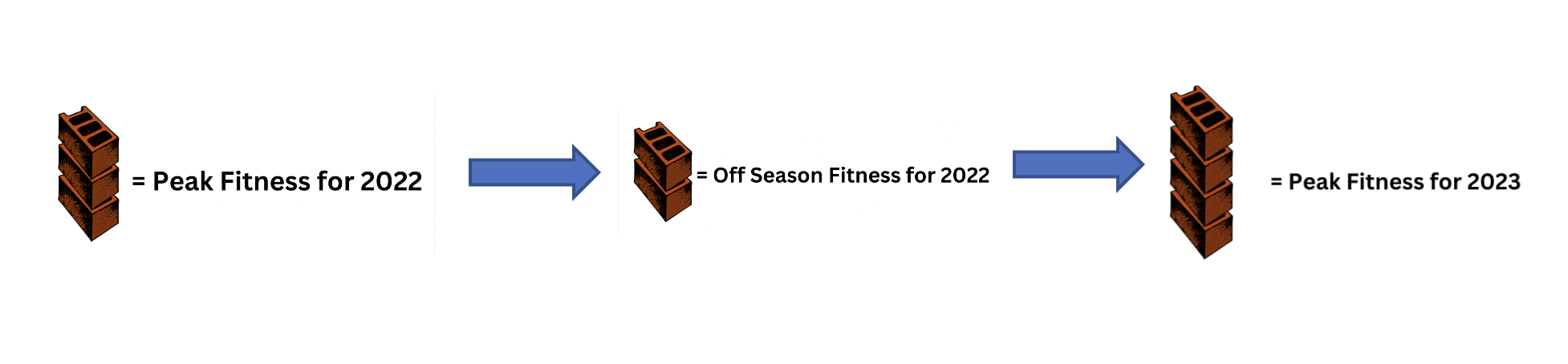
Fitness is Like a Brick Wall: Imagine your fitness is a brick wall. Over the past year of 2022, you’ve worked hard to build your fitness up to a total of 3 bricks strong. This is AWESOME! It’s the most amount of bricks you’ve ever been able to build up to during a season. When you take an off season or a break from running, realistically, you’ll only end up losing about one brick’s worth of fitness. Not too bad, right? Well, this then gives you the ability to build your fitness up to four bricks strong for the 2023 season. You still had the foundation of your two bricks, and better yet, you could build off of that and continue to get more fit than you ever have before. If you’re a visual learner, here’s what I mean:
There’s a bit more nuance to all of this, and of course there are limitations and exceptions, but this is the general idea of why you take rest periods. You will not be starting from 0, but losing a little fitness ultimately helps you gain more fitness in the years to follow.
Running and Self-Worth: To those who really struggle to let go of big training weeks, I find that it’s important for them to look inwards and ask themselves if they’re perhaps putting too much of their self-worth in running. And to those people, I hear you! I’ve been there. In fact, most of my life I’ve been playing various sports and always struggled with putting a lot of my self-worth into athletic outcomes or how much training I was doing. I ultimately figured out that this actually hurt my performance, made it unenjoyable. I would’ve done better if I had just taken the rest when I needed it.
Your self-worth should never be tied to running. Try to find other things that you can do while your body takes its time to rebuild itself. Again, I know this is easier said than done. But, I was somebody who always put my self-worth into sports and couldn’t find happiness somewhere else, but this was just a lie I was telling myself. When I realized this, I was able to find joy in so many things – helping people, being of service, adding quality to other people’s life. This may look different for you, but I truly think there’s always a wide variety of things people are good at and enjoy.
A heart rate monitor is great tool, but here’s some of the mistakes Coach Sage sees most often when used by runners. Coach Sage has touched on this topic a lot over the years, but he thought it needed to be updated based on some new technologies, the latest research, as well as people asking a lot of questions about heart rate based training.
🥇 Don’t compare your heart rate to others.
The first mistake people make is comparing their numbers to other runners. The numbers are relative. It’s very genetic-based when it comes to your heart rate. This is true for your maximum heart rate, as well as how your heart rate may change over time. You may have heard the rule of thumb that as you get older, it drops one beat per year of life, or it’s 220 minus your age. This is not usually the case! 🙅
Your heart rate changes as your fitness improves – especially your resting heart rate. Your whole zones could also shift over time, so me (Sage) running at seven-minute mile pace (or four minutes per kilometer pace) at 150 beats per minute, and you’re running at that pace at 180 beats per minute doesn’t necessarily mean you’re working harder or closer to your threshold than me. It may be the same sort of effort for you even though your heart rate number heart rate value is totally different. Likewise, someone may also be at 120 beats per minute and be breathing very hard and working very hard. The important take away is that there is some genetic variation in heart rate ranges between your max and your minimum heart rate.
📣 It’s NOT worthwhile comparing heart rate numbers, so don’t get caught up comparing yourself to your peers. 📣
🥈 Don’t be a slave to your sensor.
The second point I want to make is don’t be a slave to your sensor! There’s a lot of sensor error that can happen — even if you have something like a chest strap. It could trip errors, like accidentally tuning into your cadence (i.e., how many steps you’re taking in a minute). Even if you have some chest hair, it may read inaccurately. If the strap’s too loose or too tight, or it’s not getting a good connection with the electrical signals of your heart right, again, these things all cause errors.
Same thing with optical straps and sensors, which are typically found on the back of high-end running watches. These are even less accurate, generally, because for them to work, it needs to be very sensitive to surges of blood in your veins using an infrared sensor. That doesn’t always work a lot of times for many people — especially if it’s cold outside and you have cold hands. Additionally, the circulation differs between people, and yet again, the genetic variation comes into play. Finally, wrist straps are not great at getting an accurate reading especially when you’re running or you’re exercising, because your heart rate is constantly changing and fluctuating. So realize your threshold zones don’t magically change by a huge amount overnight. You don’t reach a new max without knowing it!
Now let’s talk about what IS valuable when it comes to heart rate. There is value in your resting heart rate. To get this number, you could use a sensor like a pulse oximeter at resting levels. When you wake up in the morning and you’re calm and relaxed (before you’ve had any coffee or other stimulants), you could try to get a resting pulse resting heart rate reading. Of course, you could do that manually over a span of 60 seconds by counting how many heart beats you feel. Do this by placing your fingers on your throat (you can also Google how to do this) or just over the heart to get a pulse reading over 60 seconds. If you track your resting heart rate over time and it comes down, it’s a good indicator your aerobic fitness is improving.
You can also use resting heart rate as an indicator if you had a stressful event going on. Maybe you had a bad night of sleep. Maybe you drank too many beers the night before! Maybe you’re over training a little bit. All of these things would most likely result in you having an elevated resting pulse in the morning. In conclusion, it’s not a bad idea to keep track or a log of your resting heart rate to see how it changes over the course of your training cycle.
🥉 Most people don’t know their true, 100% max heart rate. The third mistake people make when training to heart rate, is if they’re doing “zone training” (e.g., Zone one, two, three, four, five), but not actually basing their zones on their true, 100% max heart rate. Some people like to use arbitrary formulas like, “220 minus your age” to find your max heart rate or “180 minus your age” to find your easy aerobic range. These numbers don’t always work as there’s a lot of genetic variation and your heart rate ranges and values are a moving target. A lot of people will not know their hundred percent max heart rate and there are only a few “good” ways to figure it out. The first is a Vo2Max test in a lab which will usually allow you to get up to a 100 max heart rate. There are some workouts and tests you could do, like a well-paced 3k race or two-mile race for example, progressively loading, and building to that hundred percent. But it’s very painful and still very hard to pull out of 100 max heart rate value. In reality, trying to base your zones off your 100% max heart rate is kind of a crap shoot, and that’s why I wouldn’t be a total slave to the numbers and the sensors without knowing getting some vo2max testing if that’s the route you want to go.
If you remember anything, remember this: 🙌
If you want to “un-complicate” your running life, here’s what I try to encourage my athletes to do: Go by perception. Go by your breathing rate. Know that if you want to build aerobic base, most miles are going to be low intensity aerobic base building miles. Even most of my miles (~80%) are these easy, base building miles.