Coach Ray shares her tips on how to improve yourself as a runner
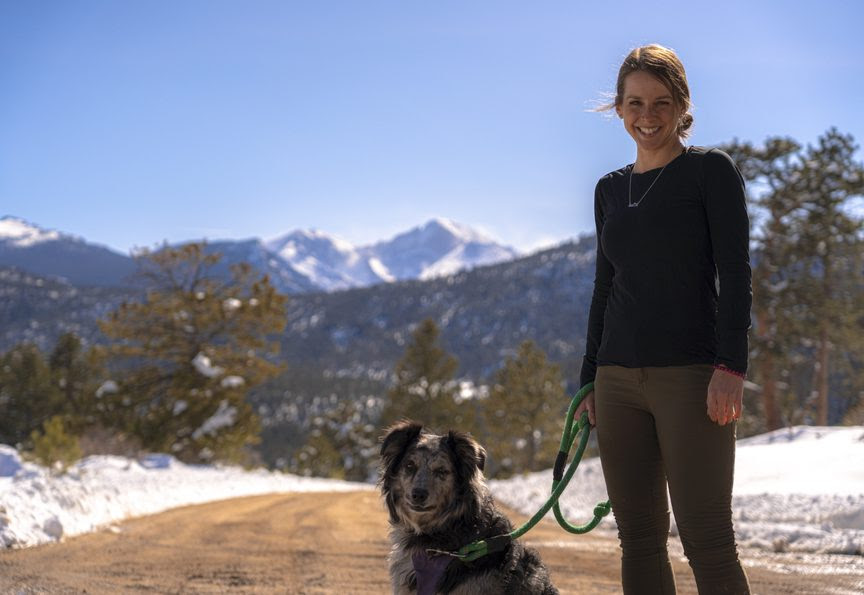
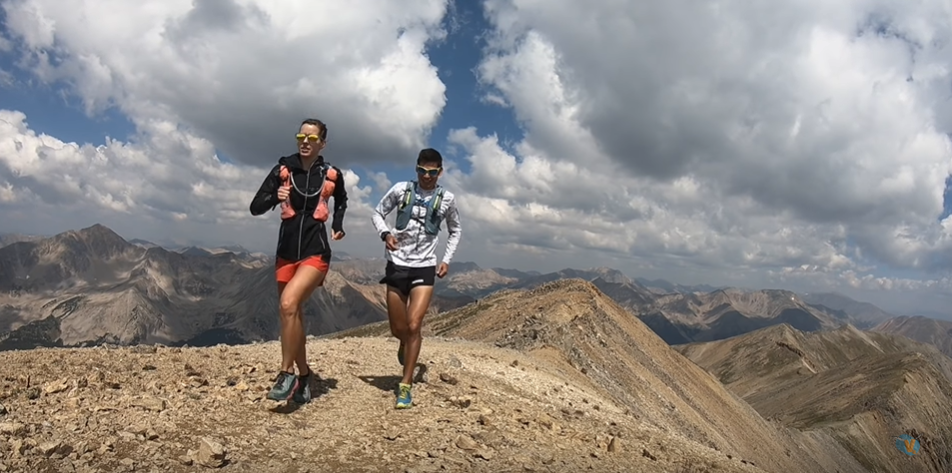
| First, here’s a little bit more about who Coach Ray is: Coach Ray is a Lydiard II certified coach who has been part of the Higher Running team for 6 years. She has competed in numerous trail races, from 5 miles to 100 miles. Most notably, she came in 2nd at Burning River 100 in 2011, 1st place at Virgil Crest 100 in 2012, 1st place at Forget the Pr 50k in 2014, and 1st place at Leatherwood Ultra 50 Miler in 2015. In August of 2015, Ray thru-hiked the 500 mile Colorado Trail with her pup and adventure partner, Pacer (aka. Supergirl). In 2019, the pair completed their goal of summiting 40 of Colorado’s 14ers. At Higher Running, she enjoys coaching runners embarking on new adventures and who use running as a modality to discover more about themselves. Ray’s hobbies include reading, volunteering, Yoga, snowshoeing, rollerblading, and exploring new places with her daughter(dog). |
 |
| Okay, let’s jump right in: “In my coaching experience, there are a few things that runners can do that almost always yield positive results for them and their running. First, I should explain that my passion for coaching falls in line with my mission of helping others reach their full potential in all aspects of life, and therefore, I carry a strong mind/body/spirit focus in my coaching. Of course, I know the importance of using the science when designing any of my athletes’ training plans. But when I’m coaching my athletes, I also have them focus on the following: Mindset  I look at mindset as “everything.” Mindset is what informs us of what we can and can’t do as athletes. In terms of creativity, I recognize that my athletes are all dynamic and unique individuals. They all have different things going on in their life, their bodies adapt differently, they respond uniquely to various stimuli, so I’m constantly trying to figure out what’s the best thing for them at that specific time. What this means for other people reading this is that you have to recognize that mindset will be the determining factor of how you approach a certain training situation. What do you need in this current situation you’re in? Your mindset will help determine this. I look at mindset as “everything.” Mindset is what informs us of what we can and can’t do as athletes. In terms of creativity, I recognize that my athletes are all dynamic and unique individuals. They all have different things going on in their life, their bodies adapt differently, they respond uniquely to various stimuli, so I’m constantly trying to figure out what’s the best thing for them at that specific time. What this means for other people reading this is that you have to recognize that mindset will be the determining factor of how you approach a certain training situation. What do you need in this current situation you’re in? Your mindset will help determine this.Listening to your body This is something I think a lot of people underestimate when trying to improve themselves as runners. If they notice a niggle (or some type of minor twitch), many people tend to ignore it because they treat it as something they can work through. I’m sure many of us have heard the quote that “pain is weakness leaving the body.” While there definitely is good pain to fight through, all-too-often people try to train through injuries. Our bodies hold so much wisdom and gifts for us, and they’re designed to heal. However, we have to listen to the messages our body is giving us in order to heal.Listening to yourself To tag along on my previous point, we must be willing to listen to ourselves. A lot of the time, people know what they’re supposed to do and how they should respond if they take a moment to think about it. But the problem is, is that most people don’t take time to listen to their inner voice guiding them to do what’s best for their body. This is something I still work on myself! Just the other day, I took two days off of running, and I was so proud of myself because I knew that my achilles heel needed it. Listening to yourself can be so difficult because we live in a culture that doesn’t necessarily value our intuition or what our body is saying to us. As a result, our logical, rational mind overrides what our intuition and body is telling us. The point here is to lean into our body’s own natural wisdom. Dealing with Bad Races / Performances I think it’s fair to say we’ve all had bad races. Or, even if you don’t like to race, we’ve gone out on a run and felt terrible because nothing went the way we planned for it to go. I remember one time when I was racing “Forget the PR 50km” in Mohican, OH, and I totally underperformed from what I thought I was capable of doing. I wanted at least top three, and I didn’t get it. At the end, I was sulking, didn’t talk to anybody, and crying at the end. To be clear, I think it’s totally okay to cry at the end of a race / performance that didn’t go accordingly to plan. However, because I sulked and shied away from people, that didn’t feel good. I had two people come up to me after the race and let me know that, “hey, it’s okay! It’s just a race, and this doesn’t define you.” This eventually helped me to realize what’s important to me in life. So even after a bad races, now I still like to hangout with people and connect with them. At the end of the day, that’s really what it’s all about. I guess all this to say, is that after a “bad” (however you define that) performance, it’s okay to feel sad because I know you worked so hard for it. However, the flip side of that is there is still an opportunity to connect with the amazing humans around you. Don’t define yourself only as a runner, but I encourage my athletes to strive to be good athletes and good people to everybody at the end of the day. That’s all that I had for this week! There are so many more things that one can do to yield positive results in their running, but these were just a few things that first came to mind.” |

 You may find yourself not being able to travel to the race early enough to get a true sense of the terrain. Or, it’s not feasible to take a separate trip out to scope the route. Something like Transvulcania is on an exotic island, so you may only have race day to really take in the actual landscape. Don’t sweat it! These days, there are plenty of information available on online forums, videos, and websites for almost every ultramarathon out there, with a few exceptions (looking at you, Barkley Marathon…). We encourage our athletes to try to get a sense of the terrain by Youtubing videos of other people doing the race. Add the location of the race to your weather app weeks in advance so you can try to see what could possibly happen throughout the course of the race. Use an app like Strava so you can look at people who have done the course before. This way, you can see the gradients some of the hills are.
 I’m sure this isn’t the answer you were looking for, but the treadmill can be an amazing tool for those needing to practice gaining some serious vertical. By no means am I saying that you need to run every run on this, but even if you can get a key workout in here and there on the treadmill and incorporate workouts with an incline that would mimic your race terrain, you’ll have a tremendous benefit from it. Even if you just use the treadmill to do an all uphill “power hike,” it will help you out tremendouslyNote: If you’re unsure how much vertical you should add to your training plan, or what good workouts are for ultra marathons, we explain our thoughts in detail in our Training Guide (included with all training plan purchases). Our Ultra Marathon Training Plan will give you even MORE tips and tricks for uphill and downhill efforts.
 Yes, I realize this newsletter is for people who are not able to access hilly and mountainous terrain. But, I encourage you to try and find a hill or two somewhere that you could make work. Again, even if you can only get to it one day a week for a key workout, this will really help your climbing abilities. A staircase or bleachers can also substitute vertical gain. Once you’ve found your coveted hill, do hill repeats at an easy to moderate pace. On the flip side of this all, doing this will also help prepare your quads for the downhill. We often find that people underestimate the amount of stress your quads take on the downhill, and you don’t want them to give out halfway through the race!

 nsity effort in the morning. Try to let it digest (some would say up to two hours) before heading out on a run, but this can vary person-to-person. However, a 6-8 mile run with no calories beforehand is totally doable (9-12 kms). We always encourage our athletes to have a glass of water before they go out for their run, whether they eat or not, because you usually wake up slightly dehydrated.
 Eating a banana or a few dates – this is light on the stomach and quick to digest.· Granola bar· Half a cup of oatmeal (i.e., a smaller portion of oatmeal than what you would typically eat for a full breakfast)·
  One piece of toast with peanut butter