I wanted to share something that happened to me a few years back, where I found myself in a bit of a predicament at the beginning of the 2022 running season.
I had already known which races I wanted to do for a while but couldn’t bring myself to sign up. That’s because there was something I wasn’t feeling good about. Personally, I think it’s so important to align and then act, at least when I can. It’s something I’ve always tried to practice, and I’m still working on it to this day! It doesn’t come easily because, if I’m being honest, this feeling of being “out of alignment” with the races I wanted to do probably lasted a few weeks before I took the moment to acknowledge it. That’s why I wasn’t signing up, even though I had planned to.
Finally, one week, I sat down and took a moment to think about why I wasn’t feeling good about the races anymore. And then, this is the important part, I took out my notebook and pen, and I wrote down two very important things:
1. How I wanted to feel about the race
2. how I wanted to think about the race.
And doing that created a huge shift for me.
Sometimes these shifts take time. This shift was actually pretty fast because I took that moment to align. This is stuff I know; when you’re feeling bad about something, it’s important to acknowledge it. I wasn’t feeling that bad, but it just wasn’t where I wanted to be feeling.
Take a moment to acknowledge when you’re not feeling great, to acknowledge why, and then think about how you want to be thinking about a situation. That’s such a guidepost for me, and I hope it is for everybody. Our feelings are so important, so we shouldn’t just go through the motions, but instead, take a moment to reflect on this misalignment.
And I’m obviously not perfect!
It took me a few weeks to get there, but I did. You can’t beat yourself up about not doing things as soon as you should because constantly learning, and the fact that I did take the moment and sat myself down was huge. Who cares if it took a few weeks?
I did it. I felt better. I got that shift, and I was able to sign up for the races. And most importantly, as soon as I did that, I noticed that all my runs felt a little bit lighter. I was able to get that joy feeling, especially going uphill or sending a downhill. Like running, it instantly became more fun because I was back in alignment with how I wanted to feel about racing and running.
Here’s my takeaway for you: it’s essential to listen to our inner voice and acknowledge when something isn’t quite right. Taking the time to realign ourselves with our true desires and goals can lead to profound shifts and a renewed sense of joy. While it may take time to get there, the important thing is that we make the effort and take the necessary steps towards alignment. So, let’s remember to be patient with ourselves, embrace the learning process, and prioritize our well-being and authenticity in our journey as runners and individuals.
These are some practical tips for navigating the trail safely, effectively, and efficiently, aiming to minimize the risk of tripping and falling while conserving energy for those challenging mountain trails:
Tip #1: Your ArmsIf you’re looking to increase your downhill speed, let’s dive into the technical sections. Firstly, your arm movement is crucial. It won’t be a typical, uniform arm swing. You need to counteract the balance and side-to-side motion of your momentum and weight with your arms. Feel free to swing them wide and high! Use your arms to balance as your legs navigate the technical rocks, requiring them to move from side to side. Imagine yourself flying and utilize wide arm swings, almost like a windmill.
Tip #2: Light, Quick StepsTip number two emphasizes the importance of taking small, quick steps while navigating downhill trails. Your stride rate could surpass 200 steps per minute, especially when speeding down a technical trail. To effectively maneuver the terrain, envision yourself dancing with it—employ quick, light footwork. Constantly remind yourself: “quick feet, quick feet.” It’s better to err on the side of shorter steps rather than attempting to jump across a gap. Avoid overreaching and overstriding, which could lead to potential missteps on rocks. Instead, opt for quick, stutter steps between technical obstacles.
The advantage of these quick, light steps is twofold. Firstly, they reduce the likelihood of heel striking. Landing with your body mass centered and maintaining a slight forward lean, ideally perpendicular to the downhill slope, ensures better control. Secondly, landing with less force minimizes the risk of tripping and falling. In the unfortunate event of turning an ankle, the reduced force behind the landing mitigates the impact and helps you maintain better overall control on the descent.
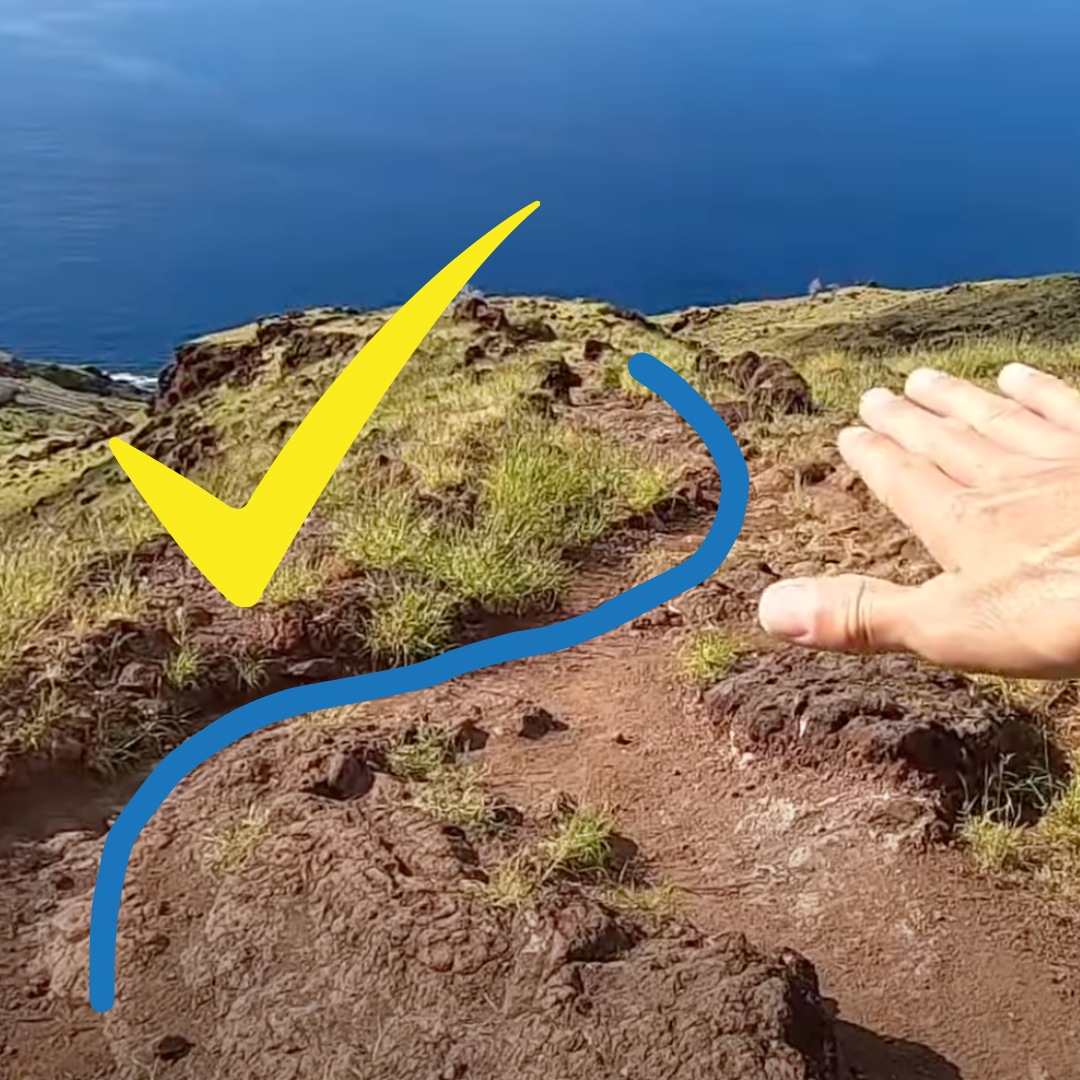
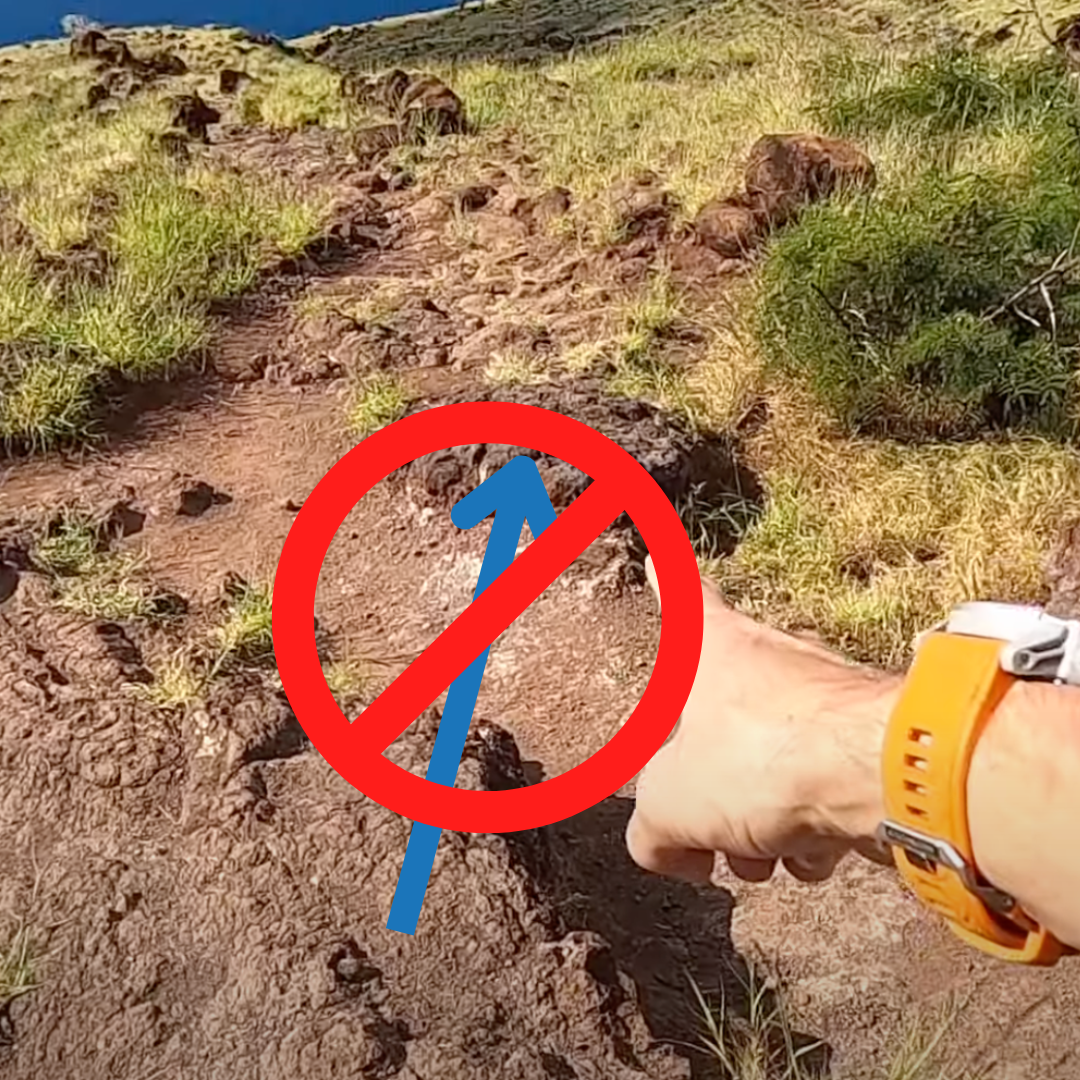
Tip #3: Line SelectionThe third and final tip for today emphasizes the importance of selecting your trail line wisely. When faced with undulating terrain, consider weaving from side to side rather than attempting a straight path. Negotiating a series of controlled turns, almost like slaloming in skiing, is often a safer and more efficient strategy than tackling large jumps or trying to go straight across. Here’s what I mean by that:
On first glance, it might make sense to jump from one rock to the other, because it’s the most direct path. But this gap could be dangerous with even the slightest misstep!If I go this way, I’m going with the turns and can maintain more control as I run with the curvatures in the trail.
Imagine yourself riding a mountain bike or skiing down similar slopes; having the ability to control your trajectory from side to side not only helps manage speed but also allows you to choose the optimal path. Opting for a controlled descent with slight side-to-side movements is less risky than attempting large jumps to cut off distance.
In this approach, it’s crucial to maintain a forward-looking perspective. Look ahead, scanning the ground at least 10 to 15 feet in front of you, anticipating your next several steps. By doing so, you can plan where to plant your feet and strategically pick your line down the slope to avoid obstacles. Drawing from experiences in activities like mountain biking, skiing, or other sports provides valuable insight into the art of picking the best line as you navigate downhill slopes.
Thank you for tuning in to this brief tutorial on downhill technical trail running tips. If you found this information helpful, be sure to explore our website, HigherRunning.com, where you can find even more FREE and helpful running resources. Happy running,- Sage Canaday
Today we’re addressing one of our most frequently asked questions: “What do I do when I need to make an adjustment to my training plan?” If it’s a training plan from Higher Running, we give you some advice in our Training Guide (included with every training plan) on what to do if you get sick, have a family obligation, or whatever else comes up in life. Today, however, Coach Sage is going to take a bit of a deeper dive into how to adjust your training when life gets in the way:
I’m excited to dive into a crucial aspect of running that often gets overlooked – adapting your training plan when life throws unexpected challenges your way. Many of us, especially those who are self-coached, tend to stick rigidly to our plans. But let’s face it: life is unpredictable, and learning to adjust is a key skill for any runner.
On HigherRunning.com, we offer what some might call “cookie-cutter” plans, but the reality is far from that. We rate these plans based on various factors such as weekly mileage, training background, and the precious commodity of time. But here’s the catch – modifying a plan isn’t a one-size-fits-all endeavor. Life’s hiccups, be it illness, time constraints, or minor injuries, force us to reassess and adapt.
Let’s talk about illness. It’s not a black-and-white scenario. The severity of symptoms matters. A persistent cough, fever, or other more serious signs might warrant a more extended break. However, missing one high-intensity workout doesn’t mean the end of the world. It’s the overall consistency that shapes your fitness journey. I’m not going to touch on this too much in today’s newsletter, as I broke this down extensively quite recently. You can check that out HERE.
Time constraints present another challenge. Life can throw a curveball, especially when work demands or family commitments suddenly take priority. Picture this: extra hours at the office, sleep slipping away, and all your energy—both mental and physical—getting sucked into a demanding work project or deadline. Your boss and co-workers might be throwing extra tasks your way, making running the last thing on your mind. On the flip side, family matters, like holiday commitments or unexpected emergencies, can disrupt your routine. Making dinner for the in-laws, dealing with school issues with your kids, or heading out on vacation—all these things mean less sleep, more stress, and running dropping down your priority list. It’s not just about skipping a few days; it’s about realizing that your whole plan might be thrown off balance. Juggling time constraints and added stress, both mentally and physically, can make it tougher to gear up for a hard run or workout. When you’re mentally drained from extra work, sleep deprivation, and less-than-ideal nutrition, finding the motivation for a challenging run becomes a real struggle. It’s a delicate balance, considering the mental and physical toll that stress can take on your energy levels and enthusiasm for your running routine. This will be something that you will probably have to figure out for yourself. Are there better days of the work for you to do workouts? Are you going to have to move around a rest day due to a family obligation? Understanding what will work best for you takes time, but we can never stress enough to listen to your body and take care of yourself.
Considering your injury history is also a crucial piece of the puzzle when tailoring your running plan. The goal is to build a robust aerobic base by hitting higher mileage, but there’s a delicate balance to strike. We want you to push your limits without risking injury, overtraining, or compromising your speed and intensity. The last thing you need is to fall victim to sickness or injury. That’s precisely why we offer different levels of training plans and varying durations.
Some plans span 12 weeks, while others stretch to 16. We might even recommend dedicating 3 or 4 weeks to building an easy aerobic base. In certain cases, we suggest starting with our FREE Aerobic Base Building Plan before diving into the main training plans. The decision hinges on your experience level and your specific injury or overtraining history. It’s all about crafting a plan that aligns with your individual needs and minimizes the risk of setbacks.
And then there’s the unavoidable – travel. Whether it’s for work or leisure, sometimes you’re on the move. Adjusting key workouts by a couple of days can be acceptable, but here’s the golden rule – don’t stray too far from the core plan. There’s a method to the madness in training plans, and excessive alterations can backfire.
However, I want to stress the big picture. The goal is to have a consistent sequence of workouts stretched over weeks and months. Whether your goal is reaching peak fitness, hitting a personal record, qualifying for the Boston Marathon, conquering an ultramarathon, or acing your fastest 5k, it all boils down to the accumulation of efforts. Imagine it like building a puzzle—one piece at a time. It’s not just about one or two workouts; it’s about the dozens of them, including those easy days that might seem less intense but play a crucial role in shaping your overall fitness.
Let’s say you miss one of those long runs. Take a deep breath; it’s not the end of the world. In a well-structured training plan, you’re likely to have more of those big long runs coming up—maybe half a dozen or even up to ten in a standard marathon training plan. So, keep the big picture in mind and remember that consistency over time is the real secret sauce to achieving your running goals.
Coaching, as I’ve learned over the years, is a blend of science and art. It involves understanding genetics, mental attitudes, lifestyle factors, age, and more. It’s complex, and we’re just scratching the surface.
Questions? Always feel free to send us an email: support@higherrunning, and we’ll get right back to you.
Today, Coach Sandi Nypaver will give you some tips to train a high-performance mindset to help you achieve your 2024 goals. The concepts in this newsletter have made a huge difference for her as well as the athletes that she coaches who have fully committed to them! Thanks to neuroplasticity anyone can develop a high-performance mindset with the right focus:
Hope you’re all kicking off the year on the right foot! It’s Coach Sandi here, and I’m excited to share these eight tips to help you on your running journey.
1. Stay Present, Embrace Today: I’ve learned that focusing on the present moment is the key to reaching those distant goals. Sure, I might have a race in mind, but making the most of today is how I build towards success. Find joy in each run, even in the cold and snowy days!
2. Write It Down, Make It Visible: I’ve got a little trick for boosting goal achievement – write it down and keep it in your line of sight. Make your goal your phone wallpaper or put it on your computer desktop. Seeing it every day is a powerful reminder to stay committed.
3. Uncover Your “Why”: When setting goals, ask yourself why it matters. It doesn’t always have to be a profound answer. For me, it often boils down to the simple joys and the feeling of accomplishment. Knowing your “why” keeps you motivated through thick and thin.
4. Harness Positive Self-Talk: Positive self-talk has been a game-changer for me. I still mess up on camera sometimes, but embracing positivity has kept me going. It’s not about perfection; it’s about progress. Try it out, and you might be surprised at the difference it makes.
5. Audible and Visual Fuel: As someone who learns both audibly and visually, I surround myself with motivating podcasts, music, and visual reminders. Find what speaks to you and keeps your mind in sync with your goals.
6. Seek Pleasure in Challenges: Change your mindset from dreading hard workouts to embracing the pleasure they bring. It’s all about perspective. Challenge yourself to redefine what you consider “hard,” and you’ll find yourself enjoying the journey more.
7. Prioritize Your Feelings: Here’s a bit of unconventional advice – care about how you feel. Your emotions are powerful indicators of what serves you. If something doesn’t make you feel good, recognize it and make choices aligned with your well-being.
8. Your Surroundings Matter: Everything around you, from the TV shows you watch to the music you listen to, can impact your mood. Choose elements that uplift and energize you during your runs and in your daily life.
Let’s make 2024 a year of strides, joy, and mindful running!
“Today, I want to share a story that takes us back to the Canyons 100k, an event that unfolded about two years ago, where things didn’t quite go as planned.
At the time, I was really excited for the Canyons 100k, with the allure of a mostly uphill course, starting at 1,000 feet and reaching 5,000 feet. It was a challenge I was ready to tackle head-on. But, as life often teaches us, plans can take unexpected turns.
The decision not to participate in Canyons 100k was a tough one. Despite my excitement, a nagging feeling told me I wasn’t at my optimal performance level. A recent revelation about my ferritin levels being lower than usual served as a crucial insight into my physical condition.
I believe there were two factors contributing to this decline: my recent move to 7,000 feet in altitude and an oversight in adjusting my iron supplement regimen. Altitude has a known impact on ferritin levels, and a delayed blood test only compounded the issue. Lesson learned, albeit the hard way. I’ve known from past experiences that high altitudes pose challenges.
The second reason was a bit of a facepalm moment – I switched to an iron supplement that wasn’t as potent as my previous one. Silly mistake, but it happens.
Now, let’s rewind a bit further to my journey in refining my running form. About three years ago, during the Black Canyon 100K series, I opened up about reshaping my motor patterns after dealing with a chronic Achilles injury. Those childhood patterns of being pigeon-toed and walking on my toes haunted me and probably contributed to my Achilles issues.
While most days my form felt on point, bad days still snuck in. A race a month before Canyons 100k left me feeling off-kilter. Entering a 100k without 100% confidence in my body just didn’t sit right with me.
Reflecting on this journey from two years ago, setbacks happen, even to the most seasoned runners. What matters is how we respond. Here are a few timeless takeaways:
1. Prioritize Health : No race is worth compromising your well-being. Regular check-ups and listening your body’s signals should be non-negotiable.
2. Altitude Awareness : Living and training at high altitudes comes with challenges. Stay informed, consult professionals, and keep tabs on your health.
3. Embrace Adaptability : My journey post-injury highlights the importance of adapting. Embrace change, refine techniques, and be patient with progress.
As I reflect on Canyons 100k from two years ago, I’m grateful for the running community’s support. We’re bound by resilience and a shared love for the sport. Here’s to the journey!”